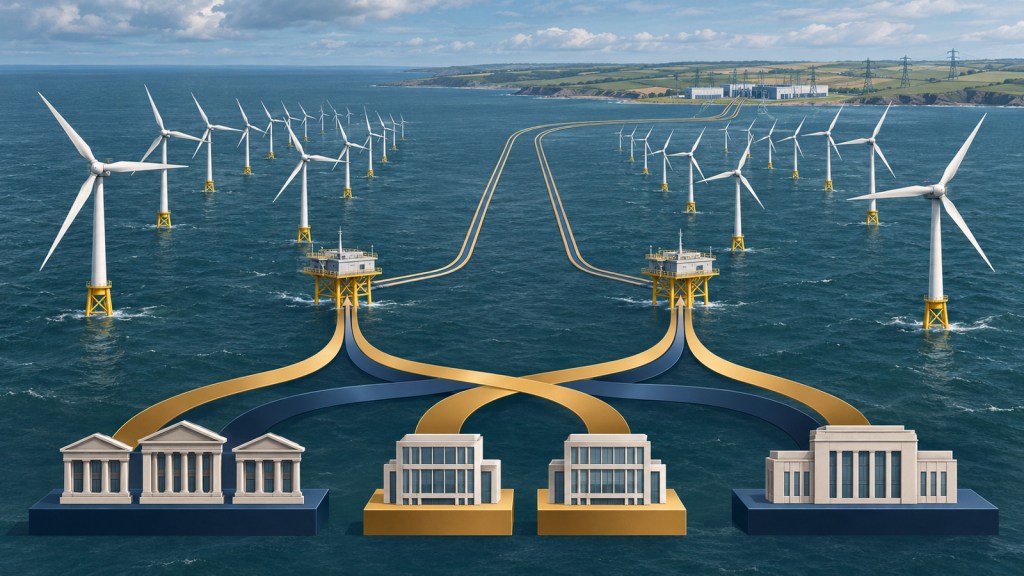
RWE and KKR have reached financial close on two UK offshore wind farms with £11.1 billion of non-recourse cash facilities, £1.7 billion of ancillary facilities and equity from a 50:50 joint venture. The projects are expected to cost about £12 billion in total. The important finance story is not simply the size of the investment: it is how contracted revenue, sponsor equity, public participation, export-credit support and a 35-bank lending group have been assembled to make a four-year construction program financeable.
The judgment
- Implication: The financing reduces the sponsors’ direct balance-sheet concentration and spreads lender exposure, but it does not make construction risk disappear. The value case still depends on delivering two 1.4-gigawatt projects by 2030 within the cost, schedule and operating assumptions behind the debt package.
- What would change the conclusion: A disclosed equity bridge, financing margins, reserve requirements and sensitivity cases could show how much downside the structure can absorb. Material cost escalation, commissioning delay, weaker availability or costs that rise faster than the inflation-linked power price would weaken the case.
- Management action: Track the projects with one integrated sources-and-uses model that separates committed cash, contingent facilities, sponsor equity, public lending, covered debt, construction contingencies and the milestones that release each capital tranche.
What closed
RWE and KKR said on November 11 that financial close has been reached for Vanguard West and Vanguard East, two planned offshore wind farms in the British North Sea. Each project is designed for 1.4 gigawatts of capacity. Offshore construction is scheduled to begin in early 2027, with both projects expected to be fully commissioned in 2030.
KKR has completed its acquisition of a 50% equity interest in each project, creating a 50:50 joint venture. RWE will lead project delivery for the venture. The companies described the combined investment as approximately £12 billion, including the wind farms and related transmission infrastructure.
The financing package contains £11.1 billion of cash facilities and £1.7 billion of ancillary facilities from 35 international banks. It also includes a £1 billion commitment from the UK National Wealth Fund and credit cover from Germany’s Euler Hermes and Denmark’s EIFO. RWE described it as the largest non-recourse project financing yet secured for UK offshore wind.
The three headline numbers are not interchangeable
The £12 billion investment estimate, £11.1 billion of cash facilities and £1.7 billion of ancillary facilities describe different parts of the structure. Adding the two facility figures and calling the result project spending would overstate the disclosed construction budget.
Cash facilities can fund eligible project costs under their agreements. Ancillary facilities commonly support instruments such as guarantees, letters of credit or other contingent obligations; the announcement does not provide a detailed breakdown. They provide capacity, but they are not automatically cash capital expenditure. Sponsor equity fills another part of the sources-and-uses plan, yet RWE and KKR did not disclose the amount or timing of their equity commitments in the announcement.
That distinction matters for boards evaluating any large capital program. Facility capacity, expected spending and equity at risk should be reconciled rather than compressed into one “investment” number. The same discipline applies to Alliant Energy’s $15.9 billion power plan: funding availability does not establish project economics, and a demand or revenue contract does not eliminate execution risk.
Non-recourse debt reallocates risk; it does not erase it
Non-recourse financing generally means lenders rely primarily on the project companies, their contracts and their assets rather than on an unrestricted claim against the sponsors. That can isolate project debt from the wider corporate balance sheet and allows multiple capital providers to underwrite a defined pool of cash flows.
The label does not reveal every risk allocation. Project financings can include completion support, equity commitments, reserve accounts, performance tests, hedging requirements, covenants and conditions before lenders release funds. The November 11 announcement does not disclose those details, so it would be unsafe to infer that RWE and KKR have capped every form of sponsor exposure at an already-funded equity amount.
The 35-bank syndicate reduces concentration for any one lender, while export-credit cover and the National Wealth Fund commitment can broaden the capital base. A large syndicate also raises coordination demands. Waivers, amendments and responses to schedule or cost pressure must work across a complex creditor group, even when an agent bank manages the process.
The revenue contract is a major risk control
Both projects secured 20-year, inflation-indexed Contracts for Difference in the UK’s seventh allocation round at a strike price of £91.20 per megawatt-hour in 2024 prices, according to RWE. A CfD can reduce exposure to wholesale power-price volatility by settling the difference between a reference price and the contract’s strike price, subject to the scheme terms.
That contracted framework is central to debt capacity because it can make a large portion of future revenue more predictable. It does not guarantee the return. The projects still must be completed, connected and available to generate power. Inflation indexation can protect revenue from broad price changes without perfectly matching the timing and composition of turbine, vessel, cable, labor, maintenance and financing costs.
A finance model should therefore keep at least four sensitivities separate: construction cost, completion date, operating availability and the gap between indexed revenue and actual cost inflation. Combining them into one downside percentage can hide interactions. A delay may increase financing cost, postpone revenue and expose the project to a different cost environment at the same time.
Public participation should be measured as a risk-bearing position
The UK government described the National Wealth Fund’s £1 billion commitment as its largest offshore-wind investment to date. The policy rationale is to mobilize private investment, support domestic energy security and earn a return for the public institution. Those goals are compatible, but they are not self-verifying.
The useful accountability questions are financial: what instrument the fund holds, where it ranks in the capital structure, how it is priced, what protections it receives and what losses it could bear under delay or underperformance. The public announcement establishes the commitment, not its complete risk-adjusted return. Export-credit cover should be evaluated in the same way: it changes who absorbs specified losses and on what terms; it does not turn the underlying construction work into a risk-free activity.
A board model should follow capital through the milestones
- Sources: separate RWE equity, KKR equity, commercial bank cash facilities, the National Wealth Fund commitment, covered facilities and ancillary capacity.
- Uses: distinguish turbines, foundations, vessels, transmission assets, onshore works, development costs, financing costs, reserves and contingency.
- Release conditions: connect each draw to permits, contracts, manufacturing progress, installation milestones, grid readiness and completion tests.
- Downside funding: identify which party supplies capital first when costs rise or revenue starts later, and when additional support becomes discretionary rather than committed.
- Operating evidence: after commissioning, track availability, curtailment, maintenance cost, insurance, working capital and cash available for debt service against the financing case.
The free Forecast Scenario Planner can help keep cost, timing and operating cases separate, although a project of this scale requires a dedicated cash-flow and debt model. The broader principle also appears in AI Financing Boom Shifts the Test to Cash Flow: a large facility is evidence of funding capacity, not proof that the asset will earn its hurdle rate.
The bottom line
RWE and KKR have assembled a financing structure large enough to move two major offshore wind farms from development toward construction. The combination of long-term contracted revenue, sponsor equity, non-recourse lending, public participation and export-credit support explains why lenders can fund the projects at this scale.
The £12 billion figure is still a budget, not a return. The finance judgment will be visible in the bridge from commitments to draws, from construction milestones to commissioned capacity, and from inflation-linked contracted revenue to cash after operating costs and debt service. Risk has been distributed with considerable sophistication. It has not been eliminated.
Sources
- RWE, “RWE and KKR join forces to deliver 2.8 gigawatts of new offshore wind capacity in the UK,” November 11, 2026
- KKR, project financing and joint-venture announcement, November 11, 2026
- UK government, “Prime Minister hails major investment in UK renewables,” November 11, 2026
- Reuters, “RWE, KKR finalise $16 billion investment in UK renewables,” November 11, 2026
Announced terms, capacity, schedules and financing amounts are reported facts attributed to the sources above. Explanations of the financing structure, risk allocation, sensitivities and management actions are Numbers & Judgment analysis.


Leave a Reply