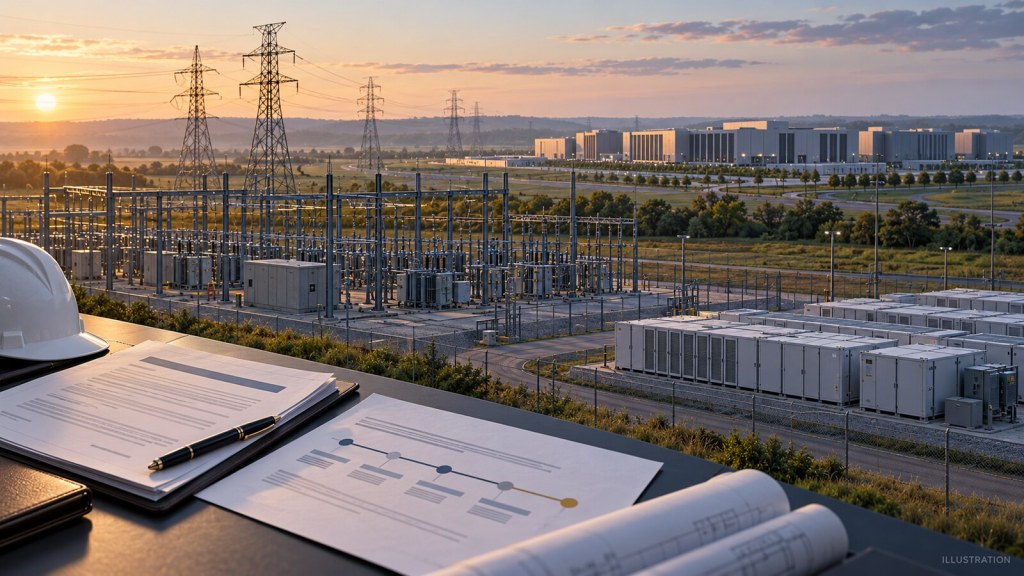
Alliant Energy’s updated capital plan turns a data-center demand forecast into a financing and execution test. The regulated utility says it now has 3.4 gigawatts of contracted data-center demand and expects peak system demand to rise about 60% by 2031. To serve that load, it raised projected capital spending for 2027 through 2030 by 19% to $15.9 billion.
The growth opportunity is substantial, but the contracts, regulatory approvals, construction schedule and financing must arrive in the right order. A large signed load does not produce cash before the generation, storage and grid assets are placed in service and allowed into rates.
The judgment
- Implication: Contracted data-center demand can support a larger utility investment program, but it does not eliminate construction, regulatory, funding or customer-concentration risk. The useful measure is not contracted megawatts alone; it is capital that reaches service and begins earning an approved return.
- What would change the conclusion: Stronger evidence on customer credit support, termination protection, project approvals, in-service dates and rate recovery would make the expanded plan more financeable. Delays, cost overruns or weaker load commitments would increase the amount of capital carried before revenue arrives.
- Management action: Maintain a contract-to-capital bridge for every major load: committed megawatts, customer and guarantee, construction milestones, capital required, funding source, expected service date, regulatory recovery and downside exposure.
The $15.9 billion plan is concentrated in generation
Alliant’s filing shows $15.935 billion of projected spending from 2027 through 2030 before rounding. Numbers & Judgment calculates that roughly $6.8 billion is assigned to thermal generation and liquefied natural gas, while about $5.1 billion is assigned to renewables and energy storage. Electric distribution accounts for about $2.3 billion; gas distribution and other spending make up the balance.
Those calculations come from the company’s published annual table and are not separate company guidance. They show why this is more than a demand forecast. The plan requires multiple asset classes, long construction timelines and regulatory decisions across Iowa and Wisconsin.
Alliant’s 2027 earnings guidance also makes the dependencies explicit. Its $3.63-to-$3.73 ongoing earnings-per-share range assumes that the utilities can earn authorized returns, execute the capital plan, realize expected data-center revenue and complete their financing and cost-control plans. The guidance is therefore conditional on both building the assets and converting demand into recoverable revenue.
The federal loan lowers cost; it does not remove the funding problem
A $5.1 billion, 30-year federal loan package improves the financing case. The Department of Energy says the package can support more than 2.6 gigawatts of new or upgraded generation and storage. Alliant estimates up to $1.2 billion of cumulative customer savings over the loans’ life.
But the loan package should not be subtracted mechanically from the $15.9 billion capital plan. The periods and eligible projects are not identical, and individual advances remain subject to project advancement, qualification and financing terms. The facility is funding capacity, not cash already received for every planned project.
That distinction resembles the earlier analysis of Tesla’s credit facilities: gross committed borrowing capacity is not the same as unrestricted cash. Finance teams need an availability bridge that shows eligible costs, timing, conditions, expected draw dates and the remaining need for debt, equity or operating cash flow.
Contracts have to match asset and financing risk
Reuters reported October 30 that Alliant expects to contract roughly another gigawatt of data-center demand within six months. That would strengthen the growth case, but it would also raise concentration and sequencing questions. Management must know whether the customer commitment lasts long enough, and is creditworthy enough, to support the useful life and financing period of the related infrastructure.
The contract review should identify minimum load, ramp dates, security or guarantees, termination payments, delay responsibility and what happens when the utility’s project is late or the customer’s facility is not ready. A take-or-pay provision can protect revenue, but only if the counterparty and legal structure make it enforceable. A forecasted gigawatt without adequate protection can leave the utility carrying assets and financing costs ahead of demand.
This extends the logic in Google’s Power Agreements Put Contracts Behind New Capacity. Long-duration commitments can make infrastructure more financeable without transferring every construction and operating risk to the customer. The contract is a financing asset only when its duration, credit support and remedies match the capital exposure.
Rate recovery and customer affordability are part of the capital model
Alliant says it is extending Iowa retail electric base-rate stability through 2030 while earning its authorized return. That creates a useful discipline: the capital plan must support growth without allowing financing, depreciation and operating costs to outrun the revenue path.
For boards and finance teams, the downside case should not stop at a higher construction estimate. It should test a slower customer ramp, delayed regulatory recovery, higher financing cost, additional equity issuance and a mismatch between project service dates and contracted load. Customer savings from lower-cost federal financing help, but they do not compensate for every form of execution risk.
The free Capital Project ROI & Payback workbook can help structure base and downside project cash flows. A regulated-utility model would need additional schedules for allowance for funds used during construction, rate base, depreciation, tax effects, financing and regulatory lag.
The decision metric is capital converted to service
The strongest version of Alliant’s plan is a matched sequence: durable customer commitment, approved project, lower-cost funding, on-time construction, in-service asset and recoverable revenue. The weakest version is a mismatch in which capital is committed before customer or regulatory protection is sufficiently firm.
Management should therefore report more than aggregate megawatts and capital spending. A useful quarterly bridge would show contracted demand by expected ramp year, capital committed and spent, projects awaiting approval, financing secured and drawn, assets placed in service, and revenue already flowing. That is the evidence needed to determine whether the buildout is creating value or merely expanding the balance sheet ahead of cash.
Sources and method
- Alliant Energy third-quarter 2026 results and 2027 guidance, filed with the SEC October 29, 2026.
- U.S. Department of Energy loan-closing announcement, October 28, 2026.
- Reuters reporting on additional data-center demand, October 30, 2026.
Company figures, guidance assumptions and project descriptions are reported from the cited sources. Category totals are Numbers & Judgment calculations from Alliant’s published capital table. The conclusions about contract quality, financing, rate recovery and management controls are Numbers & Judgment analysis.


Leave a Reply