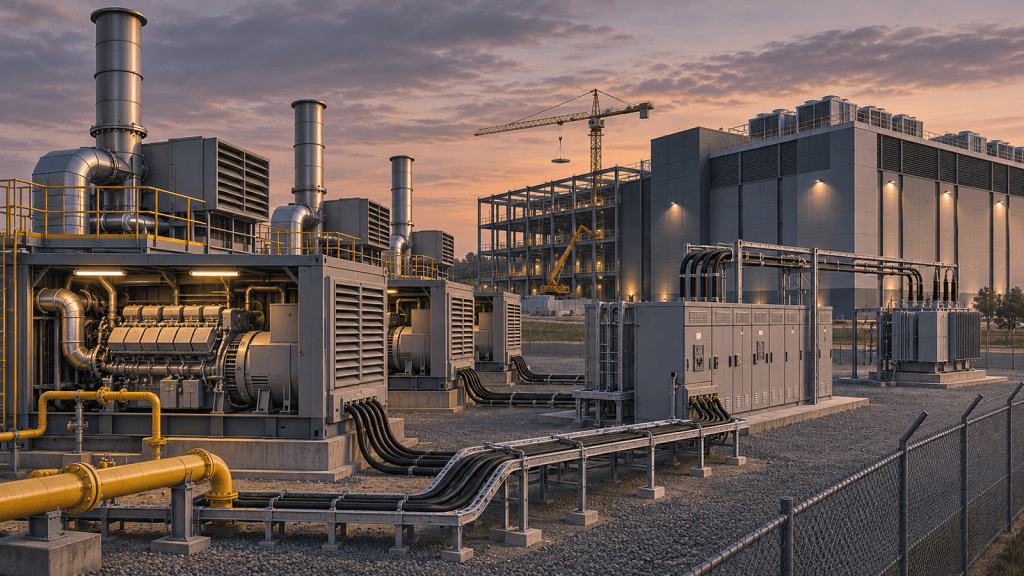
The Financial Times reported on November 8 that Anthropic agreed in late September to pay $3.4 billion for commitments covering 1.7 gigawatts of Caterpillar gas-fired generators originally ordered by OnePWR Solutions. The reported transaction is more than another AI-capacity announcement: it would move an AI developer closer to controlling the equipment that produces its electricity.
The facts remain incomplete. Anthropic and OnePWR declined to comment to the Financial Times, and Reuters said it could not independently verify the report. The analysis below therefore treats the amount, capacity and structure as reported information—not company-confirmed disclosure.
The judgment
Implication: Direct control of scarce generation equipment can shorten the path to data-center power, but it also concentrates construction, fuel, permitting, operating, maintenance and utilization risk around the AI company rather than leaving those risks entirely with utilities or infrastructure partners.
What would change the conclusion: Confirmed contract terms showing that most execution and residual-value exposure remains with creditworthy counterparties, that payments are milestone-based and cancellable, or that the generators are already matched to permitted sites and contracted demand would reduce the commitment risk. A denial or material correction by the parties would change the factual basis.
Management action: Build a site-by-site commitment bridge showing equipment ordered, payment schedule, construction status, permits, fuel supply, interconnection, expected available capacity, customer demand, financing source and the cash consequences of delay or underutilization.
What the reported deal would change
According to the Financial Times, OnePWR had ordered the generators roughly two years ago but needed financing to complete the purchases. Anthropic reportedly moved from planning to buy power from OnePWR to taking over the equipment commitments, including engineering and construction capabilities needed for installation. The report said Anthropic did not acquire OnePWR itself and that no OnePWR employees transferred.
That distinction matters. Buying electricity under a service agreement, acquiring a company and assuming equipment orders create different control, accounting and execution profiles. The public reporting does not establish when title transfers, what has already been paid, whether commitments are cancellable, which party holds construction obligations, or how much of the $3.4 billion relates to equipment rather than engineering and installation.
Finance teams should resist treating the reported amount as a single current-period capital expenditure. A purchase commitment is not automatically the same as cash paid or an asset placed in service. Recognition and disclosure will depend on the contractual rights, delivery terms, control of the equipment, payment milestones and applicable accounting guidance.
Equipment control does not guarantee usable power
Generators solve only part of the capacity problem. Usable data-center power also depends on sites, fuel supply, emissions and other permits, construction, switchgear, transmission or local distribution, cooling, maintenance, redundancy and commissioning. The 1.7-gigawatt figure is reported equipment capacity, not evidence that 1.7 gigawatts are continuously available to operating data centers today.
The attraction is still clear. Manufacturing lead times for large generators have stretched, and earlier equipment orders may provide access sooner than placing new orders. Direct control can also reduce reliance on a utility schedule or an intermediary whose financing is uncertain. In scarcity, the option value of reserved equipment can be substantial.
But scarcity can encourage buyers to commit before every downstream dependency is settled. If permitting or construction slips, equipment can arrive before a site is ready. If AI demand or model economics change, a long-lived power asset can outlast the workload that justified it. If fuel costs rise or environmental requirements tighten, the operating case can change even after the equipment is installed.
The financing decision arrives before the return
Anthropic has publicly described a broad capacity portfolio. Its official compute announcement lists access to more than 300 megawatts from SpaceX, agreements of up to 5 gigawatts each with Amazon and Google/Broadcom, $30 billion of Azure capacity, and a $50 billion U.S. infrastructure investment with Fluidstack. Those arrangements are not interchangeable with the newly reported generator commitments, but together they show how far future operating flexibility may already be allocated.
The board-level measure should therefore extend beyond reported capital expenditure. A commitment-adjusted cash view should reconcile cash on hand and operating cash generation to equipment payments, leases, take-or-pay capacity, construction obligations, debt service and other minimum payments. It should also distinguish amounts tied to operating capacity from commitments for sites that are not yet energized.
This extends the argument in AI Financing Boom Shifts the Test to Cash Flow: the ability to finance an AI buildout does not prove that each project will earn an adequate return. It also complements Alliant’s $15.9 Billion Power Plan Tests Contract Quality, where the central question is whether power assets, customer commitments, financing and revenue begin on compatible timelines.
Utilization is the economic control
The generator order may be rational even if some capacity initially sits unused. Securing scarce equipment can protect a growth option and reduce the cost of waiting for utilities. The finance question is how much unused capacity the company can carry, for how long, and with what exit alternatives.
A useful project dashboard would separate four stages: equipment reserved, equipment delivered, power available and compute capacity generating revenue. Each stage should have its own cash amount, expected date and responsible owner. Collapsing them into one gigawatt figure can make progress appear faster than the economics.
Downside analysis should test delayed delivery, delayed permitting, lower utilization, higher gas prices, higher financing costs, shorter equipment lives and an inability to redeploy generators economically. The free Forecast Scenario Planner can organize base, downside and upside assumptions and management actions. A transaction of this scale would still require a project-level cash-flow model, legal review and technical operating assumptions.
Control is valuable only when it improves the full system
The reported transaction reflects a broader change in AI infrastructure. Developers are no longer only customers of chips, data centers and electricity; they are becoming direct allocators of long-lead physical assets. That can improve speed and bargaining power. It can also move risks onto a balance sheet before the related revenue is observable.
The strongest evidence will be confirmed terms, equipment delivery, permitted sites, reliable fuel, energized capacity, high utilization and cash generation that supports the full cost of the commitment. Until then, $3.4 billion and 1.7 gigawatts describe reported scale. They do not yet establish return.
Sources and evidence
- Financial Times, “Anthropic strikes $3.4bn deal to generate gas-fired power for data centres,” November 8, 2026.
- Reuters, “Anthropic secures $3.4 billion generator deal for AI data centers, FT reports,” November 8, 2026.
- Anthropic, “Higher usage limits and a SpaceX compute deal”.
The transaction amount, capacity, timing and structure are reported facts attributed to the Financial Times and summarized by Reuters; they have not been publicly confirmed by the parties. Conclusions about commitment risk, accounting questions, utilization, governance and management action are Numbers & Judgment analysis.


Leave a Reply