November 4, 2026 | Robert Young
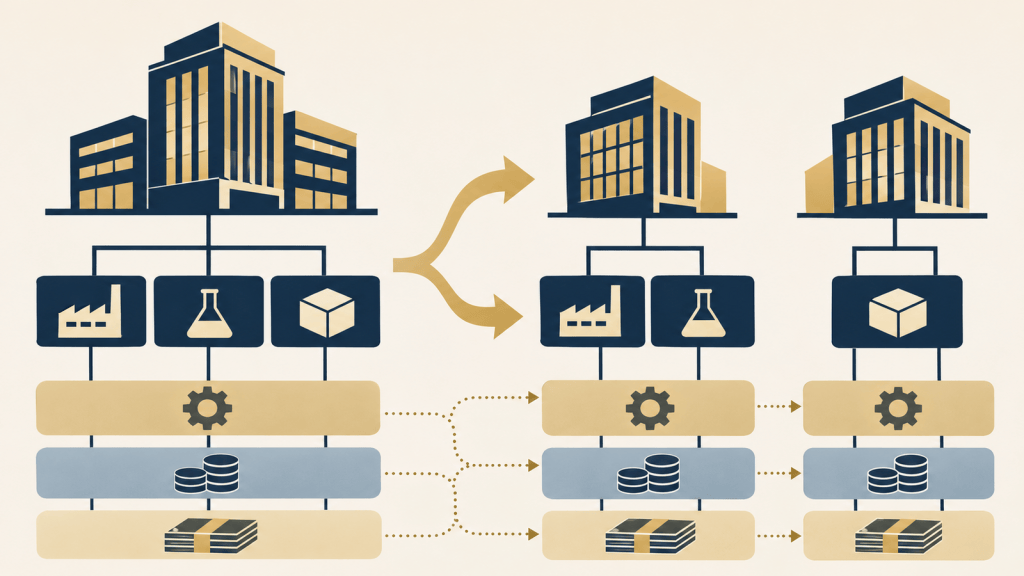
CVS Health plans to separate into two publicly traded companies in the first half of 2028, dividing a vertically integrated healthcare group into a health-solutions company and a pharmacy-led consumer business. The strategic argument is simplification. The financial question is harder: how debt, cash generation, dividends, shared infrastructure and stranded costs will be allocated before the separation.
The judgment
- Implication: A split may improve strategic focus, but value creation depends more on the opening balance sheets and removal of duplicated costs than on the legal separation itself.
- What would change the conclusion: Detailed pro forma disclosures showing durable standalone cash flow, manageable leverage and limited stranded costs for both companies.
- Management action: Publish a separation bridge covering debt allocation, capital needs, dividend policy, transition services and dis-synergies well before the transaction closes.
Two businesses, one current balance sheet
CVS said the health-solutions company would include Aetna, Caremark, specialty pharmacy and healthcare services. The pharmacy company would include roughly 9,000 retail locations, MinuteClinic, mail-order pharmacy and the consumer platform. Shareholders are expected to own stock in both companies.
The company expects the transaction in the first half of 2028, subject to approvals and other conditions. Management said the separation should create clearer strategic focus and capital allocation. Those benefits remain forward-looking until investors can evaluate each company’s standalone economics.
Stronger cash guidance does not answer allocation
CVS separately reported third-quarter revenue of $108.4 billion, up 5.4%, adjusted EPS of $2.09 and year-to-date operating cash flow of $15.3 billion. It raised full-year operating-cash-flow guidance to at least $15.5 billion from at least $11.5 billion.
That improvement creates flexibility, but consolidated cash flow does not show which future company generates the cash, which consumes capital or how working-capital volatility and regulated capital requirements will be divided. The separation case needs segment-level cash conversion, not only consolidated earnings.
The missing map
- Debt and ratings: allocate debt, interest expense and refinancing needs without weakening either company’s resilience.
- Dividends and buybacks: explain whether current shareholder distributions can be sustained by each standalone cash-flow profile.
- Shared services: quantify temporary transition-services costs and permanent duplication across technology, finance, procurement and corporate functions.
- Regulated capital: separate cash that is economically available from cash needed inside insurance and other regulated entities.
- Commercial dependencies: disclose agreements that will replace today’s internal relationships between insurance, benefit management, specialty pharmacy and retail channels.
Investors reacted negatively after the announcement, according to Reuters, partly because the separation arrived with limited financial detail. That reaction is not proof the strategy is wrong. It is evidence that the value-creation bridge is incomplete.
The next milestone should not be another strategic slogan. It should be a set of auditable pro forma statements and capital-allocation rules that show how each business can fund itself through a full operating cycle.
For related analysis, see the cash implications of balance-sheet remeasurement and Starbucks’ closure-and-expansion margin test. The free 13-week cash-flow forecast template can help operating teams separate liquidity from accounting allocation during a transition.
Sources and evidence
- CVS Health separation announcement, November 4, 2026.
- CVS Health third-quarter 2026 results, November 4, 2026.
- Reuters, November 4, 2026: planned separation and market reaction.
Company results and transaction plans are reported facts or management expectations. The capital-structure conclusions and recommended disclosures are Numbers & Judgment analysis.


Leave a Reply