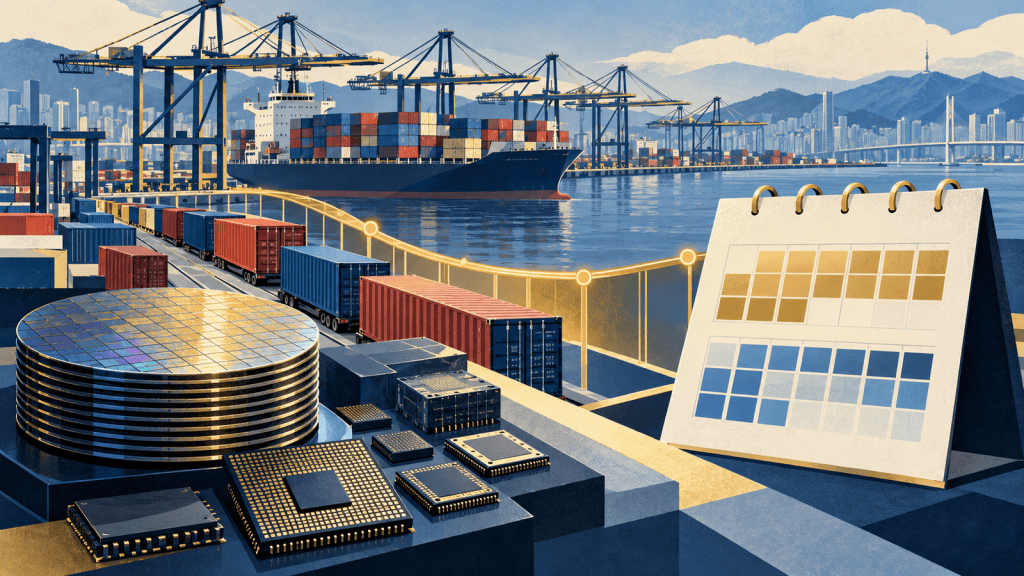
South Korea’s exports rose 93.7% from a year earlier in October to $115.28 billion, the fastest annual increase since January 1974. The number confirms that AI-related semiconductor demand remains powerful. It does not, by itself, establish that the underlying export run rate nearly doubled.
The judgment
- Implication: The AI-chip cycle is a genuine demand and cash-flow signal, but the 93.7% headline combines that strength with extra working days, a favorable comparison base and heavy semiconductor concentration.
- What would change the conclusion: Sustained workday-adjusted and sequential export growth, plus broader gains outside chips, would support a stronger underlying run rate. A reversal in memory pricing, chip volumes or big-tech infrastructure spending would weaken it.
- Management action: Build a bridge from reported annual growth to workday-adjusted, sequential and category-level growth before changing revenue, inventory, capacity or cash assumptions.
The headline is larger than the underlying acceleration
Reuters reported that October had 22 working days, compared with 20 in the prior-year month, because of the timing of the Chuseok holidays. That is a 10% increase in available working days before considering any change in daily output. Economists surveyed before the release cautioned that calendar effects and a favorable base comparison would amplify the annual growth rate.
The first 20 days of October showed the same distinction. Total exports were up 105.4% year over year, while exports on a working-day average basis rose 65.9%. The adjusted number was still exceptionally strong. The gap is the point: normalization reduces the magnitude without eliminating the demand signal.
A second comparison matters. October’s $115.28 billion of exports was below September’s level, which Reuters reported had exceeded $120 billion for the first time. A faster annual percentage increase can therefore coexist with a lower sequential dollar value. For forecasting, the level and the comparison base should be shown beside the growth rate.
Semiconductors explain almost half the export value
Semiconductor exports rose 259.4% to $56.44 billion in October. That was approximately 49% of the month’s total export value. Computer exports increased 496.6% as demand for AI servers expanded. Shipments also rose sharply to China, the United States, Europe and Southeast Asia.
Those figures support a real industrial cycle: high memory prices, strong chip volumes and continuing global investment in AI infrastructure. They also create concentration risk. A national export forecast that treats every category as if it shared the semiconductor trajectory will overstate breadth. A company forecast tied to Korea’s supply chain can make the same mistake at a smaller scale.
The relevant bridge separates price, volume and mix. Higher memory prices can lift export value without the same increase in physical output. Higher volume supports utilization and operating leverage. A richer mix of high-bandwidth memory and AI-server components can raise both revenue and margin. Each driver has a different downside scenario.
Imports and the surplus add useful context
Imports rose 36.0% to $72.78 billion, driven partly by higher crude-oil prices and demand for semiconductor manufacturing equipment and automobiles. The trade surplus was $42.50 billion, down from September’s record $49.97 billion.
For finance teams, imports are not only a deduction from the trade balance. Semiconductor-equipment imports can be an investment signal: current cash outflow may support future productive capacity. Oil imports are more directly exposed to commodity prices and working-capital timing. Combining them into one import-growth assumption obscures the different operating consequences.
The narrower surplus also shows why a record export-growth rate should not be read as a record net contribution. Gross flows, investment inputs and the net balance can move in different directions.
A better forecast bridge
Management teams exposed to the Korean technology cycle should carry at least five views of the data:
- Reported annual growth: the public headline and base comparison.
- Workday-adjusted growth: the cleaner measure of daily activity.
- Sequential dollar value: the current level compared with the previous month or quarter.
- Price, volume and mix: particularly for memory and advanced AI components.
- Category and customer concentration: how much of the plan depends on semiconductors, a small number of buyers or continued AI capital spending.
This is consistent with the timing discipline in GlobalFoundries’ $2 billion manufacturing agreement: demand commitments matter, but their financial value still depends on capacity, qualification and utilization. It also echoes the conversion risk in Nscale’s AI contract book, where contracted demand and realized revenue occupy different stages of the cash-flow chain.
The practical response is not to discount South Korea’s export surge. It is to preserve the signal while removing the distortion. The free Forecast Scenario Planner can help separate the volume, price and concentration assumptions that belong in downside, base and upside cases.
Sources
- Reuters, “South Korea exports nearly double in October on AI investment boom,” November 1, 2026
- Reuters poll via CNA, “South Korea’s October exports seen rising at fastest pace since 1974,” October 29, 2026
- Reuters, “South Korea October 1–20 exports surge 105% on record chip sales,” October 21, 2026
Reported figures above are from the cited sources. The normalization, concentration and management implications are Numbers & Judgment analysis.


Leave a Reply