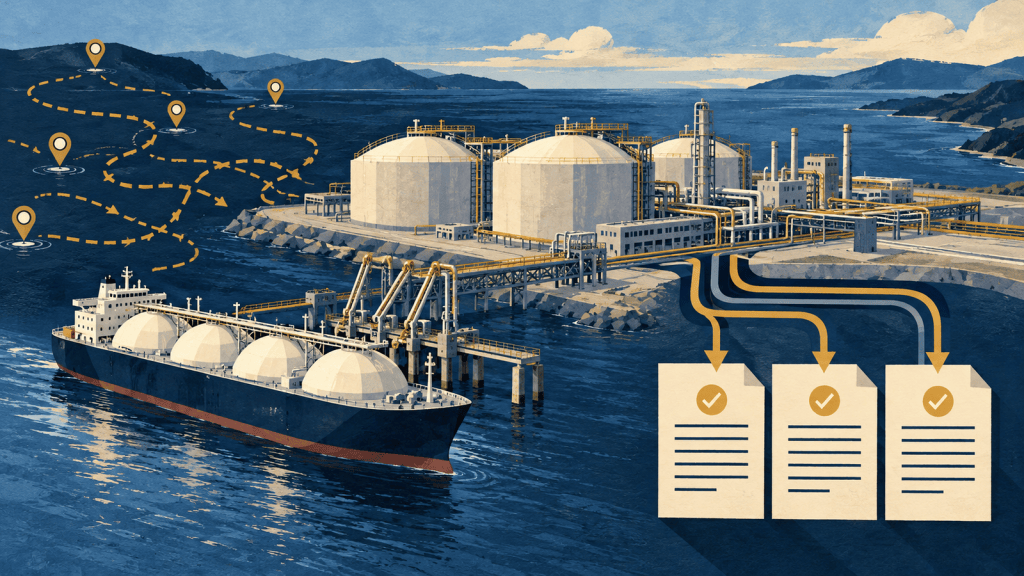
Venture Global moved Plaquemines LNG Phase 1 into commercial operations on October 31, and Shell lifted the first post-commercial-operation cargo early on November 1. The milestone changes more than the project’s operating label: it shifts a large share of output from commissioning-period sales into long-term customer contracts.
That transition should reduce exposure to unusually high spot-market prices while increasing revenue visibility. For finance teams, the relevant question is not whether contracted revenue is “better” than spot revenue in the abstract. It is whether the lower-volatility contract economics cover operating costs, debt service, maintenance and the remaining execution risk over the project’s life.
The judgment
- Implication: Commercial operation converts Plaquemines Phase 1 from a high-upside commissioning asset into a more predictable contracted-cash-flow asset. Near-term realized prices may fall from spot-market highs, but volume and counterparty visibility should improve.
- What would change the conclusion: Disclosed contract formulas, cost pass-throughs, shipping obligations, operating performance or uncontracted volumes could show that post-COD margins remain more market-sensitive—or more resilient—than the current public record indicates.
- Management action: Build a commissioning-to-contract bridge that separates volume, fixed and indexed pricing, feedgas, shipping, maintenance, working capital, debt service and excess-capacity sales. Do not use one blended realized-price assumption for both periods.
Commercial operation changes the sales portfolio
Venture Global’s November 1 announcement says Phase 1 reached commercial operation just over 53 months after final investment decision. Reuters reported that commissioning had lasted about 22 months from first LNG production and that Shell’s cargo was the first delivered under a long-term Phase 1 sales agreement.
The company’s most recent annual filing provides the scale. As of December 31, 2025, Plaquemines Phase 1 had 13.0 million tonnes per year of contracted post-COD volume under long-term sales and purchase agreements, primarily with investment-grade offtakers, plus 0.3 million tonnes per year under a three-year medium-term agreement. The long-term agreements run for 20 years.
Those numbers are contractual capacity, not a forecast of identical annual sales. Venture Global cautions that actual volume can vary with operating conditions and maintenance. The filed portfolio also includes both free-on-board and delivered-place-unloaded terms, so the timing and cost responsibilities are not uniform.
Spot upside and contract visibility are different economics
During commissioning, Plaquemines sold LNG to various customers under Venture Global’s commissioning-sales strategy. That created meaningful exposure to market conditions. Reuters reported that the facility benefited from spot sales while European and Asian benchmark prices rose sharply during Middle East supply disruption, and that long-term Phase 1 contract prices are expected to sit substantially below recent benchmark highs.
The comparison should not be reduced to “lower price equals weaker economics.” Spot sales offer upside when prices spike, but they also expose the seller to price reversals and require a repeated market outlet. A long-term contract can exchange some of that upside for committed demand, counterparty credit and a clearer basis for financing.
This is the same contract-finance principle examined in Google Power Agreements Put Contracts Behind Capacity: duration can support investment, but only if price, performance, termination and delivery risks are matched to the asset. The related GlobalFoundries analysis makes the other half of the point—contracted demand does not become cash until the operating asset performs.
Revenue was already substantial before COD
Commercial operation is not the same as first revenue. An October 7 SEC filing says Plaquemines sold and recognized revenue on 328.1 trillion British thermal units of LNG across 87 cargos in the third quarter while still in commissioning.
The filing also explains the recognition mechanics. For free-on-board cargos, revenue is generally recognized when the vessel is loaded and unmoors. For delivered cargos, recognition generally occurs at the destination. Five delivered cargos totaling 20.4 trillion British thermal units were exported in the third quarter but expected to be recognized in the following quarter.
That timing matters for forecasts. Cargo count, physical export date, revenue recognition and cash collection can fall into different periods. Finance should keep those steps separate, especially when the sales mix changes at the same time the project crosses into commercial operation.
The bridge belongs in the cash forecast
A useful post-COD model should begin with two columns: commissioning economics and contract economics. The bridge between them should identify at least:
- physical volume by contract and delivery term;
- fixed liquefaction fees and any commodity-linked components;
- feedgas basis and other operating-cost exposure;
- shipping, destination and scheduling obligations;
- maintenance downtime and reliability assumptions;
- receivable timing and working-capital requirements;
- interest, principal and reserve requirements; and
- uncontracted or excess output available for market sales.
The site’s free Forecast Scenario Planner can separate a contract case from lower-volume, higher-cost and stronger-spot-price cases. The value is not a weighted average that hides dispersion. It is seeing which operating or market signal changes the cash conclusion.
What the next evidence should show
The first commercial cargo confirms the contract phase has begun. It does not establish the mature margin of the facility. The next useful evidence will be the split between contracted and market sales, realized fixed fees, feedgas basis, Phase 1 reliability, maintenance, shipping costs and the timing of Phase 2 commercial operation.
Venture Global’s filed portfolio gives Plaquemines Phase 2 another 6.7 million tonnes per year of long-term contracted volume, while excess production above nameplate depends partly on additional regulatory approvals and operating performance. That makes the November 1 milestone important but not final: it is the point where construction execution begins to be judged against contract conversion and durable cash returns.
The broader management lesson is straightforward. A high spot price can make commissioning results look exceptional, while a long-term contract can make future cash flows look safe. Neither signal is sufficient alone. Finance has to connect the contract, the asset, the operating cost and the debt schedule before visibility becomes value.
Sources
- Venture Global, “Venture Global Commences Commercial Operations of Phase One of Plaquemines LNG,” November 1, 2026
- Venture Global Form 10-K, Plaquemines project and commercial arrangements
- Venture Global Form 8-K, October 7, 2026 operating metrics and revenue-recognition disclosure
- Reuters, “Venture Global begins supplying Plaquemines phase 1 customers under long-term LNG contracts,” November 1, 2026
Reported dates, contract volumes, contract terms, cargos, recognition mechanics and market-price comparisons are attributed to the sources above. The commissioning-to-contract framework, forecast design and management recommendations are Numbers & Judgment analysis.


Leave a Reply