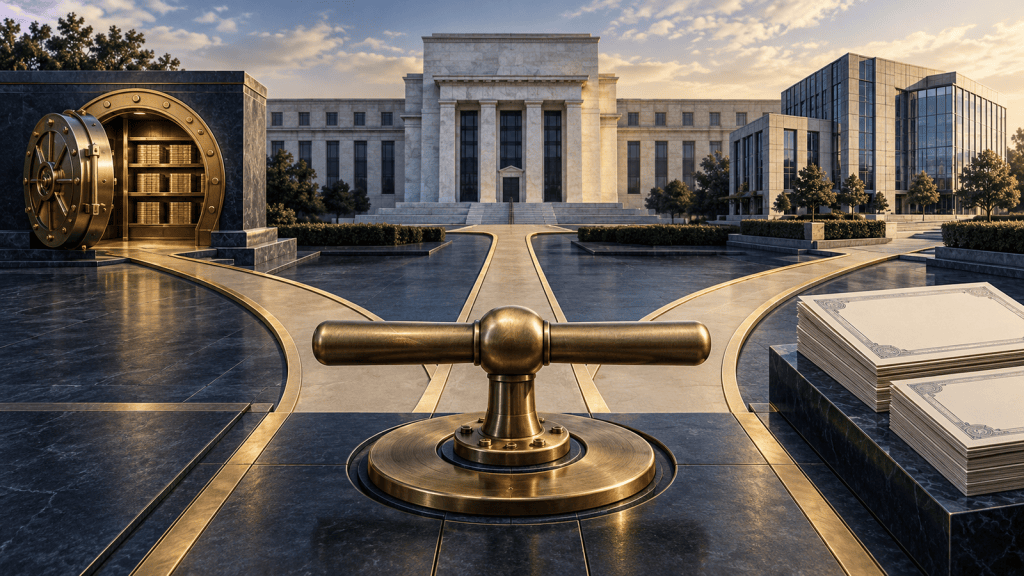
The Federal Reserve held its federal funds target range at 3.75%–4.00% on October 28, 2026, by a 10–2 vote. Both dissenters preferred a quarter-point increase. The decision leaves today’s benchmark unchanged, but the split and the Committee’s stronger assessment of activity mean finance teams should not equate a hold with lower financing costs ahead.
The judgment
Implication: The base rate is unchanged today, while the distribution of plausible future borrowing costs remains wide enough to matter for refinancing, reserves and capital spending.
What would change the conclusion: Sustained moderation in inflation, materially weaker demand or employment, or new official guidance altering the likely rate path. A single market reaction is insufficient.
Management action: Refresh the 13-week cash forecast and the 12–18-month debt and capital-expenditure scenarios with a hold case, a 25-basis-point increase case and a slower-growth case. Make contract repricing dates explicit.
What the Fed actually decided
The official October 28 statement maintained the target range at 3.75%–4.00%. It described economic activity as expanding at a strong pace, with resilient domestic spending, strong productivity growth and robust capital investment. It also said inflation remains elevated and that more information will inform the appropriate policy stance. These are the Committee’s descriptions, not a guarantee of any future action.
Lisa D. Cook and Beth M. Hammack voted against the decision because they preferred a 25-basis-point increase. A 10–2 hold therefore signals agreement on today’s rate but not unanimity about the costs of waiting. It does not, on its own, establish whether the next move will be a hike, a cut or another hold.
The implementation note retained a 3.90% interest rate on reserve balances, a 4.00% standing overnight repo rate and a 3.75% overnight reverse-repo offering rate. Those are operating details of monetary policy; they are not the borrowing rates that individual businesses necessarily pay.
Convert the decision into an actual cash schedule
For variable-rate debt, the effect of a hypothetical quarter-point change depends on the contract’s reference rate, spread, floors, hedges and reset schedule. As an illustration—not a forecast—25 basis points on $10 million of fully exposed principal corresponds to approximately $25,000 of annualized interest before tax and amortization effects. A fixed-rate borrower with no near-term refinancing may see no immediate contractual change.
Finance teams should identify the portion of debt that reprices inside 30, 90 and 365 days, then calculate the timing of interest payments rather than applying an annual rate shock to every month. Keep floating-rate exposure, fixed-rate refinancing and revolving-credit utilization in separate rows.
Protect the operating forecast from false precision
A rate hold does not mean deposit yields, supplier financing, bank spreads or bond-market yields must remain unchanged. Credit pricing also reflects borrower risk, lender capacity and market conditions. The October statement provides a policy anchor, not a complete cost-of-capital forecast.
Boards should receive a concise sensitivity bridge: current unrestricted cash, expected operating cash conversion, committed capital expenditures, debt maturities, covenant headroom and liquidity after a modest rate shock. Where a business has little floating-rate debt, operating demand or inflation may matter more than the immediate policy decision.
Reserve policy is a management choice
Cash reserves should reflect volatility in collections, seasonality, payroll commitments and access to financing, rather than a generic rule derived from the Fed’s latest vote. For nonprofits, distinguish restricted from unrestricted cash and match liquidity against the timing of grant receipts and unavoidable expenses. A scenario that survives a rate increase but not a delayed receivable is not a resilient plan.
The same discipline applies to investment approvals. Recalculate financing costs and hurdle rates where the funding structure truly changes, but do not automatically cancel projects with attractive long-term economics because the central bank held rates for one meeting.
The next evidence to watch
The key evidence is the sequence of inflation, employment, spending and financing conditions after this meeting, plus future Fed statements. The Committee’s statement is a snapshot of its current assessment. The publication’s analysis is that uncertainty belongs explicitly in management forecasts, not hidden inside a single consensus-rate assumption.
Use the free Forecast Scenario Planner to model hold, renewed-hike and slower-growth cases with explicit management actions.
Sources and related reading
Primary: Federal Reserve October 28 FOMC statement; Federal Reserve implementation note. Reporting: Reuters on the October 28 decision. Related Numbers & Judgment: Europe’s Energy Buffer Is Stronger—But Not Permanent and AEP’s $100 Billion Grid Plan Relies on Large-Load Contracts.


Leave a Reply