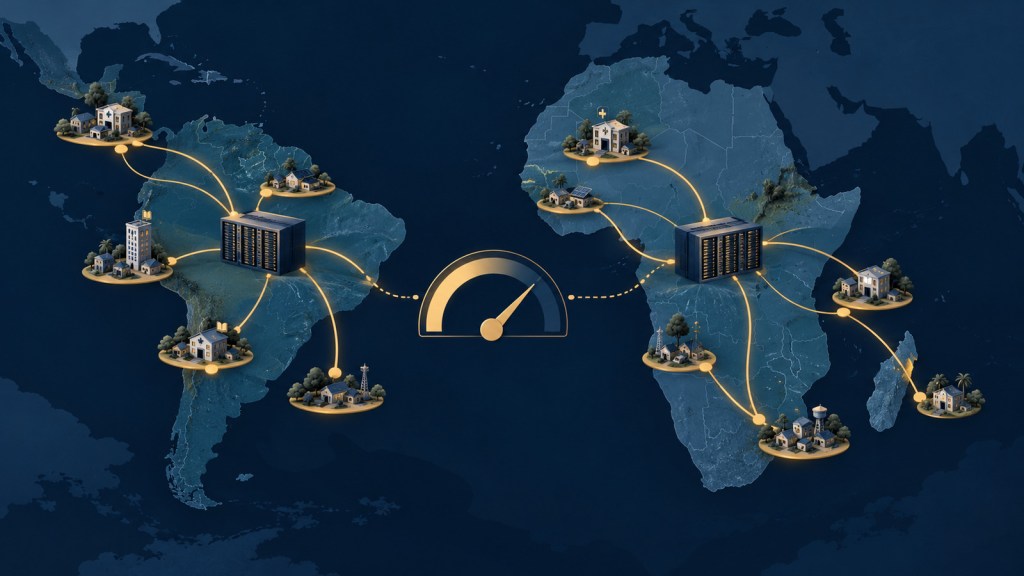
The World Bank Group has put a financing structure behind its first digital strategy: shared infrastructure, public finance and guarantees to attract private investment, plus pay-as-you-go GPU capacity for emerging markets. The approach matters because it treats artificial-intelligence readiness as a capacity decision before it becomes an asset-ownership decision.
The strategy, announced October 20, focuses on connectivity, affordability, digital services and skills, and AI readiness. Its new AI Infrastructure and Readiness Initiative will initially target Africa and Latin America and work with Cassava Technologies and NVIDIA on shared compute. The World Bank says the model offers governments access to specialized computing power without requiring each country to build a standalone national data center.
That is a sensible capital-allocation starting point, not yet a proven investment case. The announcement does not disclose the initiative’s funding size, customer pricing, capacity commitments, utilization assumptions, foreign-exchange terms or allocation of losses. Those missing numbers will determine whether shared compute becomes affordable infrastructure or merely converts a large capital commitment into an expensive operating bill.
The judgment
- Implication: Emerging-market AI programs should buy access before they buy assets when demand, power availability and utilization are uncertain. Shared capacity can preserve scarce public capital and reduce stranded-asset risk.
- What would change the conclusion: Dedicated infrastructure may be better where demand is durable, data-sovereignty requirements are binding, commercial capacity is unavailable or the all-in pay-as-you-go price exceeds a well-utilized local asset. The World Bank initiative’s economics cannot be judged until pricing, guarantees and risk allocation are disclosed.
- Management action: Compare ownership, reserved capacity and metered access using the same demand scenarios. Include power, connectivity, cooling, support, currency, data-transfer, cybersecurity and exit costs—not only the GPU price.
The strategy starts with a financing constraint
The World Bank’s release frames the digital gap as both an infrastructure problem and a resource-allocation problem. More than 2 billion people were offline in 2025. It says only 23% of people in low-income countries used the internet, compared with 94% in high-income countries. Over the next 10 to 15 years, 1.2 billion young people are expected to reach working age in developing countries while their economies create about 420 million jobs.
Those figures do not prove that digital investment will close the jobs gap. They explain why the Bank is emphasizing productivity, access and practical applications rather than national prestige projects. A government that lacks reliable power, affordable broadband or usable local data can own advanced hardware and still have little deployable AI capacity.
The strategy therefore links international cables, national networks and local connections to devices, payments, digital identification, skills and safeguards. It says public finance and guarantees can help draw private investment into underserved markets. For AI, it emphasizes “small AI”: task-specific tools for uses such as crop diagnosis, health work and inventory management.
Pay-as-you-go compute changes the unit of investment
A standalone data center is a bundle of long-lived commitments. It requires land, power, network capacity, cooling, security, specialized staff, hardware replacement and enough recurring demand to absorb fixed costs. The investment can look strategic while its economics depend on utilization that has not been demonstrated.
Shared compute changes the unit of decision. Instead of approving an entire facility, a government, university, health system or local business can purchase a defined amount of usable capacity. The relevant question becomes whether the service produces sufficient economic or public value per hour, task or user.
That can improve reversibility. Capacity can be expanded if demand proves real and reduced if a pilot does not scale. Technology-refresh risk stays partly with the provider rather than sitting entirely on a public balance sheet. Smaller users may be aggregated into demand large enough to support infrastructure that none could finance alone.
The same logic applies beyond development finance. The CFO Is Becoming the AI Capital Allocator argued that AI should be managed as a portfolio of staged bets rather than a single technology budget. Shared compute is a financing structure that can make that staging possible.
Operating expense is not automatically cheaper
Moving from ownership to metered access reduces upfront capital, but it does not eliminate economic risk. It reallocates it.
- Utilization risk: The provider carries more fixed-asset risk, but customers can still pay for reserved capacity they do not use or face high prices when demand spikes.
- Currency risk: GPU access priced in dollars can become more expensive for public budgets and local businesses even if the nominal service price does not change.
- Concentration risk: Shared infrastructure may depend on a small number of chip, cloud, network and financing partners. A lower entry cost can come with less bargaining power.
- Data and sovereignty risk: The location of data, models and processing may determine whether a technically available service is legally or politically usable.
- Continuity risk: A pilot can become operationally critical before procurement, portability and exit protections are mature.
- Hidden infrastructure risk: Compute is not useful without reliable electricity, connectivity, secure data and skilled operators. A pay-as-you-go contract can obscure those complementary costs.
This is why the headline comparison—capital expenditure versus operating expenditure—is incomplete. Finance teams need an all-in cost per useful outcome and a downside case for the commitments that remain when demand, funding or currency moves against the plan.
Guarantees must be priced as contingent claims
The World Bank says public finance and guarantees will help attract private investment into underserved markets. That can be catalytic: a limited public commitment may make a larger infrastructure project financeable. But a guarantee is not free simply because no cash leaves on day one.
The finance test is whether the guarantee is absorbing a risk that public institutions can manage better, or merely transferring an uneconomic downside from investors to the public balance sheet. Decision-makers need to know which losses are covered, what triggers payment, who controls pricing and capacity, and whether users remain affordable after the guarantee has done its job.
The site’s earlier analysis of the World Bank’s private-capital mobilization made the same distinction: leverage is useful only when the underlying risk is made investable rather than hidden. A capital multiplier can look impressive while leaving the guarantor with the tail risk. See World Bank $112B Private Capital: The Finance Lesson Is Leverage.
The ownership decision needs three comparable cases
A practical analysis should place three structures side by side:
- Metered access: Pay only for actual consumption, with minimal commitment but potentially higher unit cost and less control over availability.
- Reserved shared capacity: Commit to a base level of usage in exchange for better pricing or availability, while retaining some flexibility.
- Dedicated infrastructure: Own or finance the asset when sustained demand, sovereignty, service continuity and the local operating base justify the fixed commitment.
Each case should use the same workload assumptions and measure delivered capacity, not theoretical hardware. The model should include uptime, queue time, power and network constraints, data-transfer costs, support, cybersecurity, maintenance, hardware refresh, procurement delays and residual value. It should also show who bears unused-capacity risk.
The free Forecast Scenario Planner can keep the low-, base- and high-demand cases visible. The goal is not to forecast GPU demand precisely. It is to show which utilization and pricing assumptions move the decision from metered access to reservation or ownership.
What to watch next
The initiative’s first contracts will be more informative than the strategy announcement. Five disclosures would make the economics assessable:
- the amount and form of World Bank financing or guarantees;
- customer prices, minimum commitments and foreign-exchange terms;
- the location, power source, uptime standard and allocation of capacity;
- data-governance, cybersecurity and service-portability requirements; and
- utilization, user outcomes and the conditions for expanding or retiring capacity.
The World Bank’s choice of shared, pay-as-you-go compute is financially credible because it preserves optionality where demand and infrastructure are uncertain. The conclusion remains conditional. Capacity access creates value only when the total cost, safeguards and outcomes are better than the alternatives—and when the party absorbing the downside is visible before the contract is signed.
Sources
- World Bank Group, “World Bank Group Launches First Digital Strategy to Expand Access and Create Jobs,” October 20, 2026.
- World Bank Group, “Digital and AI,” accessed October 20, 2026.
- World Bank Group, “Building Data Infrastructure for AI Readiness,” May 6, 2026.
Facts about the strategy, initiative, partners and digital-access figures are attributed to the World Bank Group. The capital-allocation framework, scenario design and management recommendations are Numbers & Judgment analysis.


Leave a Reply