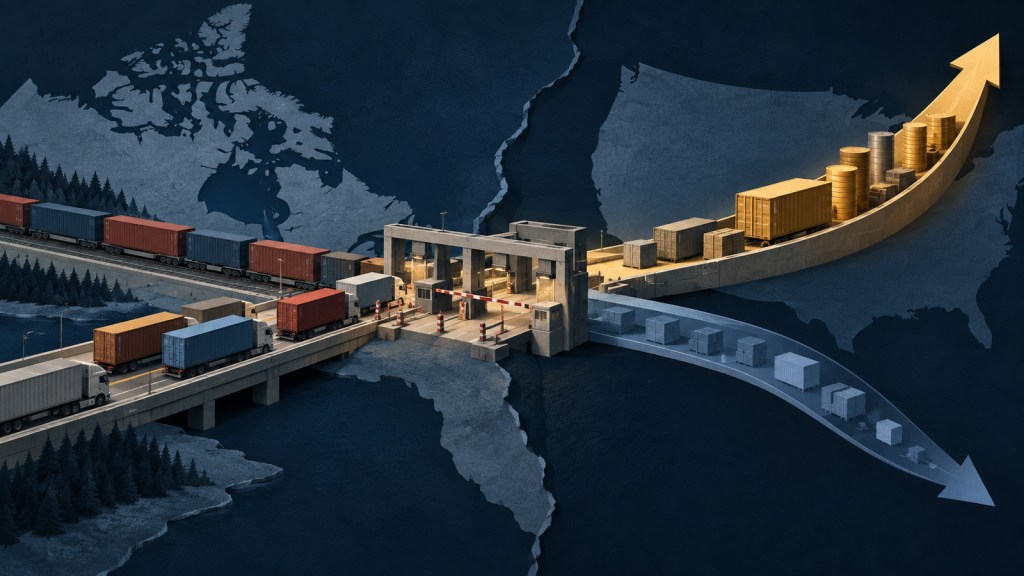
Canada’s third-quarter surveys look encouraging until the timing is separated from the average. Business sentiment, sales expectations and investment intentions improved during much of the quarter. Then Canada–United States trade talks broke down on August 21, new tariffs and counter-tariffs followed, and the later responses turned weaker on exports, investment and confidence while cost and inflation expectations moved higher.
For finance teams, the important signal is not simply “Canada slowed” or “inflation rose.” It is that a forecast built from a quarterly average can already be stale when the shock arrives late in the collection period. The operating response should distinguish the pre-shock baseline from the post-shock run rate.
The judgment
- Implication: Canada’s pre-shock improvement should not be carried mechanically into year-end forecasts. The newer evidence points to a less favorable mix: softer volume and investment expectations alongside renewed cost and price pressure.
- What would change the conclusion: A durable recovery in post-breakdown business pulses, easing energy and tariff-related costs, and stronger consumer spending plans would indicate that the late-quarter deterioration was temporary rather than a new planning baseline.
- Management action: Rebase demand, pricing, inventory and capital assumptions to conditions after August 21. Keep a separate tariff-and-energy bridge so management can see whether margin pressure is coming from price, volume, mix or working capital.
The average and the endpoint tell different stories
The Bank of Canada’s third-quarter Business Outlook Survey, released October 19, found that overall sentiment improved after deteriorating in the second quarter. Firms reported better domestic and export sales outlooks. Investment intentions eased slightly but remained robust, while hiring intentions stayed soft and most firms planned to hold headcount steady.
Those results need a timing qualifier. The survey ran from August 6 through September 2, and about three-quarters of the interviews occurred before Canada–US trade talks broke down on August 21. The Bank’s later Business Leaders’ Pulse and follow-up work showed that new US tariffs and Canadian counter-tariffs weakened export and investment outlooks, raised expected costs and prices, and partially reversed the quarter’s earlier improvement.
That reversal was material but not yet catastrophic. The Bank described it as a moderation rather than a fundamental change, and Reuters reported that the business outlook indicator edged up to -0.33 from -0.38. The share of firms planning or budgeting for a Canadian recession over the next 12 months also fell from 17% to 6%, although that measure largely reflects the earlier, more optimistic part of the quarter.
The correct interpretation is therefore conditional. Canada entered the trade breakdown with somewhat better business momentum than it had in the spring. The shock did not erase that improvement immediately, but it weakened the endpoint that matters most for a forward forecast.
Consumers add a different warning
The Canadian Survey of Consumer Expectations shows the pressure from another direction. Long-term inflation expectations rose to match already elevated shorter-term expectations, with trade tensions and energy prices cited as important drivers. Expectations at every horizon moved higher after the trade talks failed.
Consumers also reported somewhat better financial health, helped by asset values and improved confidence in the labor market. But spending intentions deteriorated from levels that were already weak. High prices remained the largest barrier, and follow-up interviews described households cutting discretionary purchases, dining out less, seeking deals and choosing lower-cost alternatives.
Reuters reported that more than half of surveyed consumers expected a recession within the next year. That is not a forecast from the Bank of Canada, and household expectations do not determine the outcome. It is nevertheless an operating risk because cautious households can reduce demand before official activity data confirm a downturn.
The risk is a price-volume squeeze
The combination matters more than either survey alone. Firms face higher tariff, energy, freight and input costs at the same time that consumers plan to spend cautiously. Businesses with larger-than-normal cost increases told the Bank they intended to keep passing those costs to customers, in some cases to recover earlier margin compression. Yet a customer who is already trading down may not accept another price increase without reducing volume.
This creates a price-volume squeeze. Revenue may look stable for a period because price offsets lower units. Gross margin can still weaken if price increases lag input costs, mix shifts toward cheaper products or promotions rise. Cash conversion can deteriorate if companies build inventory for uncertain tariff timing, customers stretch payments or suppliers tighten terms.
The distinction resembles the one in Factory Output Rises, but Capacity Still Has Slack: a stronger headline does not prove that underlying capacity or demand is tight. Here, a better quarterly business average does not prove that the exit rate improved.
Four forecast changes finance should make
1. Replace the quarterly average with a dated bridge
Separate observations before and after August 21 wherever possible. The bridge should show which assumptions changed because of tariffs, counter-tariffs, energy prices or customer behavior. This prevents a favorable early-quarter average from disguising a weaker current run rate.
2. Split price from volume and mix
Do not let nominal revenue answer the demand question. Track units, customer count, order frequency, average price, discounting and product mix. A business can report revenue growth while losing volume and weakening its future customer base.
3. Make the cost shock traceable
Build a tariff-and-energy schedule by supplier, input, contract-renewal date and pass-through right. Distinguish costs already incurred from vendor estimates and management assumptions. A visible schedule gives leaders a basis for pricing decisions without pretending the final tariff incidence is known.
4. Preserve option value in hiring and capital
Robust investment intentions do not mean every project should proceed unchanged. Projects with long lead times, uncertain imported content or demand-sensitive paybacks should be staged where possible. Soft hiring intentions and spare capacity argue for explicit release gates rather than a blanket freeze or an unchanged annual plan.
Build three cases, not one compromise
- Resilience case: trade tensions stabilize, energy costs ease and post-breakdown business sentiment recovers. Volume improves enough to support selective price increases and investment.
- Price-volume squeeze: input costs stay elevated while household spending remains weak. Revenue is supported by price, but units, mix and cash conversion deteriorate.
- Demand break: tariffs broaden, export orders weaken and consumer caution spreads into employment and investment. Management delays capital, protects liquidity and reduces inventory commitments.
The free Forecast Scenario Planner can tie each case to triggers and actions. Useful indicators include post-August business-pulse readings, export orders, customer traffic, unit volumes, supplier quotes, inventory days, receivable aging and the spread between list-price increases and realized price.
Financing assumptions also need their own line. Reuters reported that markets were pricing a Bank of Canada hold on October 28 and a possible quarter-point increase in December. That market view can move quickly and should not be treated as management’s forecast. As discussed in Bond Selloff Tightens Financing Before the ECB Moves, effective financing conditions can tighten through yields, spreads and lender behavior before an official rate decision changes.
What the board should see
The board should not receive one blended macro narrative. It should see the timeline: conditions improving, a trade-policy break, then evidence of weaker expectations and higher price pressure. The reporting package should show which assumptions still come from the pre-shock period, what has been updated and what evidence would trigger another revision.
The larger judgment is that the quarterly average remains useful history, but the endpoint is the better planning signal. Canada’s surveys do not establish a recession, nor do they prove that inflation will stay high. They do show why finance teams should avoid carrying a favorable average into a changed operating environment without a dated bridge.
Sources
- Bank of Canada, “Business Outlook Survey—Third Quarter of 2026,” October 19, 2026.
- Bank of Canada, “Canadian Survey of Consumer Expectations—Third Quarter of 2026,” October 19, 2026.
- Reuters, “Canadian firms’ outlooks dimmed after trade talks collapse, BoC survey finds,” October 19, 2026.
Reported facts and market pricing are attributed to the sources above. Forecast design, management actions and the price-volume analysis are Numbers & Judgment analysis.


Leave a Reply