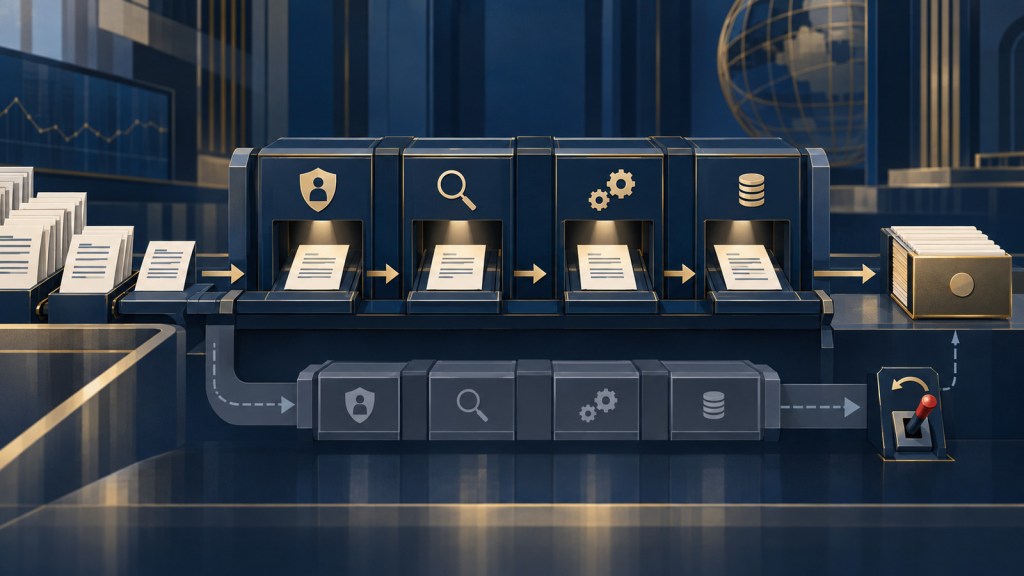
The U.S. Treasury plans to move its securities auctions to a replacement system in the coming months. That sounds like a technology upgrade. In practice, it is a control-design test for one of the world’s most consequential financial processes.
More than 400 Treasury auctions occur in a typical year, and the market they support now includes about $32 trillion of marketable debt. A successful cutover will not be defined by whether the new interface works during a demonstration. It will be defined by whether bidding, validation, award calculation, notification, settlement handoffs and contingency procedures remain dependable under real deadlines and abnormal conditions.
The judgment
Implication: A financial-system replacement should be treated as a change to the organization’s control environment, not merely an IT delivery. Reliability, authorization, reconciliation, recovery and decision rights belong in the investment case.
What would change the conclusion: Detailed public evidence of parallel processing, participant testing, failover performance and cutover tolerances could show that Treasury has already resolved the principal operating risks. Treasury’s September 22 remarks confirm final-stage testing, but do not disclose those results.
Management action: For every finance-critical system change, require a cutover scorecard that names the failure modes, evidence needed to proceed, rollback authority, reconciliation tests and the first operating-cycle outcomes the CFO will review.
What Treasury reported
These are reported facts. In September 22 remarks, Deputy Treasury Secretary Francis Brooke said the replacement auction system is in the final stages of testing and that Treasury expects to transition in the coming months. He described the system as designed to be reliable, secure and flexible.
The scale gives those adjectives unusual weight. Treasury said marketable debt outstanding is about $32 trillion and secondary-market trading averages approximately $1 trillion a day. The auction platform is one entry point into that broader market and helps Treasury pursue its stated objective of financing the government at the least cost over time.
The project was not announced yesterday. At a September 2025 primary-dealer meeting, Treasury said it was upgrading the Treasury Automated Auction Processing System, known as TAAPS, and planned participant overview sessions because the interface would change. The new disclosure is therefore a progress marker: the project has moved from planned upgrade and user familiarization toward final testing and cutover.
The interface is not the system
The following is Numbers & Judgment analysis. Finance transformations often overemphasize the visible layer. Users see a new screen, workflow or report. The actual control system is much larger.
- Who is authorized to submit, approve or alter a transaction?
- Which validations prevent incomplete, duplicate or out-of-range entries?
- How are timestamps, cutoffs and late exceptions handled?
- What independent record proves what was submitted and accepted?
- How do calculated results reconcile to settlement and the general ledger?
- What happens if a connected service fails while the primary system remains available?
- Who can halt the process, invoke a fallback or reverse the cutover?
A clean interface can coexist with weak answers to those questions. Conversely, a technically unglamorous system can be robust if its controls, recovery paths and operating discipline are strong.
Four gates before a finance-system cutover
1. Prove the critical path
The test should begin with the economic event and end after reconciliation—not stop when the new application produces an output. For an auction, that path spans participant access, bid receipt, validation, award processing, communication and downstream settlement. In a company or nonprofit, the equivalent might run from customer order through billing, cash receipt, revenue recognition and reporting.
The question is not whether every feature works. It is whether every step required to complete and account for the highest-risk transaction works within the available time.
2. Test degraded conditions
Normal-case testing establishes functionality. Degraded-mode testing establishes resilience. Teams should test unavailable integrations, delayed files, failed identity services, missing approvers, incorrect master data, high transaction volume and a primary operator who is absent.
The target is not zero incidents. It is evidence that important incidents are detected quickly, contained and resolved without losing transaction integrity.
3. Define rollback before launch
“We can go back” is not a rollback plan. Management needs a decision deadline, an accountable executive, a defined data state and a tested way to return without creating two competing books of record.
Some cutovers become effectively irreversible once new transactions enter the system. That makes the go/no-go standard more important, not less. The CFO should know which evidence is mandatory, which exceptions can be accepted and who has authority to stop the launch.
4. Measure the first live cycles
Project completion is not an outcome. The useful measures arrive after launch: rejected transactions, manual interventions, reconciliation breaks, processing time, support volume, control exceptions and whether the old system or spreadsheets remain necessary.
Those measures should be agreed before cutover. Otherwise, a team can declare success because the system went live while operations quietly absorb more work and risk.
Why the economics belong in the same review
Treasury’s stated objective is least-cost financing over time. That connects operational reliability directly to economic performance. A system disruption, participation problem or loss of confidence would not be merely an IT incident; it could affect execution and financing conditions.
Most organizations operate on a smaller scale, but the logic is the same. A billing-system delay becomes days sales outstanding. A payroll failure becomes employee and compliance risk. A donor-system migration becomes delayed acknowledgments, restricted-fund errors or lost renewal information. A treasury-workstation problem becomes cash-position uncertainty.
The business case should therefore include avoided failure cost and control quality, while acknowledging uncertainty. Those benefits are difficult to estimate precisely. That is not a reason to omit them; it is a reason to show ranges and assumptions explicitly.
A practical cutover scorecard
A CFO-ready scorecard can fit on one page:
- Critical transactions: the few end-to-end processes that cannot fail.
- Control evidence: authorization, validation, audit trail and reconciliation results.
- Resilience: recovery-time evidence, degraded-mode results and external dependencies.
- Data integrity: conversion totals, exception counts and ownership of unresolved differences.
- People readiness: trained primary and backup operators with current access.
- Decision rights: named go/no-go and rollback authorities.
- Live outcomes: thresholds for manual work, errors, processing time and reconciliation breaks.
The thresholds should reflect the process rather than a generic benchmark. A low-value planning application can tolerate more disruption than payroll, debt issuance or cash settlement. Management should explain the tolerance and the evidence supporting it instead of inventing false precision.
The broader finance lesson
Treasury’s auction-platform transition is unusually large, but the governance question is familiar: has management demonstrated that the new system can carry the economic process and its controls under real operating pressure?
That is the same distinction behind the Fed’s faster discount-window lesson: capacity is not the same as tested availability. It also complements the analysis of Treasury yields and capital allocation, because the reliability of market infrastructure helps determine how confidently that benchmark can anchor other decisions.
For teams evaluating a finance-system investment, the free Forecast Scenario Planner can help make downside, central and upside assumptions visible. The model should include implementation and disruption scenarios, not only expected savings.
A successful cutover is not the moment the old switch is turned off. It is the point at which the new system produces reliable transactions, controls and reconciliations—and the organization has evidence that it can recover when something goes wrong.


Leave a comment