UBS Chief Executive Sergio Ermotti said on November 9 that parts of the bank’s artificial-intelligence implementation have been slowed by the integration of Credit Suisse. That statement matters because UBS is not describing an AI program that lacks scale. The bank reported hundreds of live use cases, more than a thousand applications in development and broad employee adoption only days earlier.
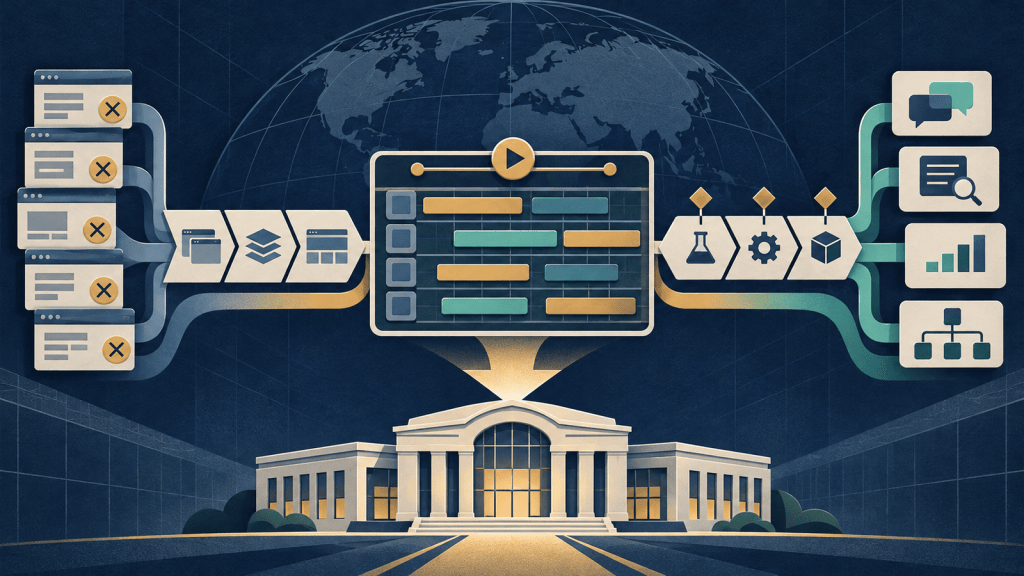
The finance lesson is not that integration has stopped innovation. It is that transformation programs draw on a common pool of data, technology, control, change-management and executive capacity. A portfolio can contain many promising projects and still be constrained by the same few bottlenecks.
The judgment
- Implication: AI use-case counts can rise while the organization’s highest-value deployments remain limited by integration work, data dependencies and scarce control capacity. Activity is not the same as throughput.
- What would change the conclusion: Evidence that the delayed AI work uses separate teams and systems, or that deployments are producing independently measured financial and client outcomes without affecting integration milestones, would reduce the case for a shared-capacity constraint.
- Management action: Put integration, AI and other enterprise programs on one portfolio view. Show shared dependencies, constrained roles, benefit owners, control gates and explicit sequence decisions—not separate dashboards that assume each initiative has first claim on the same people.
UBS is scaling AI while finishing a very large integration
Reuters reported that Ermotti told a Sydney conference some aspects of UBS’s AI implementation had been “slowed down” by the Credit Suisse integration. He also said investors had been pricing overly rapid AI progress and that infrastructure and political constraints could delay outcomes. Those are reported comments, not evidence that UBS has reduced its AI ambition.
UBS’s October 28 results point in the opposite direction. The bank said it had 608 live AI use cases in production, up 81% from a year earlier, with more than 1,090 applications in development. Employees were running more than 12,700 AI personal agents, more than 18,000 developers were using AI tools in software-development cycles, and UBS said its STAAT tool had generated more than 30 million insights for financial-adviser teams year to date.
At the same time, the Credit Suisse integration remains an enormous operating program. UBS said approximately 98% of legacy Credit Suisse applications within the decommissioning scope were no longer in use at September 30 and roughly 90% had been fully decommissioned. The bank reported $13.2 billion of cumulative gross cost savings and $14.6 billion of cumulative integration-related expenses, with year-end expectations of about $13.7 billion and $15.1 billion, respectively, at constant exchange rates.
These figures are not directly comparable as a return calculation: gross cost savings are a recurring run-rate measure against the combined 2022 cost base, while integration expenses are cumulative costs. They do, however, establish the scale of the program competing for organizational attention.
The constraint is usually shared capacity, not ideas
Large organizations rarely lack possible AI use cases. They lack unlimited access to the functions that make those use cases safe, deployable and economically useful.
- Data owners must decide which source is authoritative, how customer and transaction records are mapped and whether migrated histories are reliable enough for automated decisions.
- Architecture and engineering teams must retire legacy systems while also building the interfaces, monitoring and production environments new applications require.
- Risk, legal, cybersecurity and compliance teams must validate access, privacy, model behavior, vendor terms and escalation paths.
- Business leaders and frontline staff must redesign work, adopt new tools and absorb training while existing migration and process changes are still underway.
- Finance must separate genuine recurring benefits from avoided hiring, temporary vacancies, shifted work and benefits that depend on a future process redesign.
A project may appear fully resourced inside its own budget while still waiting on one of these shared functions. That is why individual business cases can all look feasible at the same time the enterprise portfolio is overcommitted.
Production counts are useful but incomplete
UBS’s deployment figures demonstrate scale, and the reported developer and adviser tools may create real productivity or client-service benefits. But a count of use cases or agents does not show where capacity is concentrated, how heavily tools are used, which workflows changed or whether the benefit reached the income statement.
For finance leaders, four measures belong beside the deployment count:
- Active adoption: the share of intended users completing the target workflow regularly, not merely receiving access.
- Cycle-time change: the before-and-after time for the complete process, including review, exception handling and rework.
- Capacity released or redirected: hours removed from low-value work and the specific higher-value work that replaced it.
- Realized economics: recurring cost removed, revenue or retention improved, loss avoided, or service capacity increased—net of technology, control, training and support costs.
Those measures also prevent a common error: claiming the same benefit twice. An integration may remove a legacy role while an AI project claims hours saved from the same work. The portfolio benefit cannot count both unless management can show two separate economic outcomes.
A single transformation ledger makes the tradeoffs visible
The practical response is not to freeze AI until every integration task is finished. It is to manage both programs through one constrained portfolio.
Each material initiative should identify its executive sponsor, process owner, benefit owner, required data domains, control approvers, critical technical dependencies and the month when value is expected to appear. The portfolio should then flag roles or systems committed beyond available capacity and force an explicit choice: add credible capacity, reduce scope, change sequence or stop lower-value work.
Sequence matters. Some AI applications should wait until data migration and system decommissioning are stable. Others can accelerate integration by improving code conversion, testing, document review or exception triage. The distinction should be made from dependency evidence, not from a blanket preference for either the merger program or the newest technology.
The same principle applies outside banking. A finance-system implementation, restructuring, acquisition integration, control remediation and AI rollout can all be individually justified. Together, they may demand the same controller, data engineer, security architect and business owner at the same time. The enterprise plan is credible only when that overlap is visible.
The board question is about throughput
Boards do not need a catalog of every pilot. They need to know whether the portfolio is converting limited transformation capacity into durable outcomes without weakening control or delaying a more important program.
A useful quarterly view would show a small number of enterprise outcomes, the constrained resources affecting them, integration and control dependencies, benefits realized to date and decisions required from management. The most important disclosure may be the work intentionally deferred. A portfolio with no visible sequencing choices is often a portfolio whose constraints have not been acknowledged.
UBS’s reported AI scale and integration progress can both be true. The useful judgment is that scale does not eliminate the queue. Finance leadership earns its place in transformation by making that queue—and the economics behind its order—visible.
Further reading and free tool
Related Numbers & Judgment analysis: Fastenal’s First FP&A Team Starts Lean With AI examines how finance teams can add technology without losing operating discipline; Public Media’s $87 Million Bridge Fund Moves From Rescue to Redesign separates temporary transformation funding from recurring outcomes. The free Board Finance Dashboard Template can help connect major initiatives to liquidity, forecasts, thresholds and named decisions.
Sources and methodology
- Reuters, November 9, 2026 — Ermotti’s comments on AI expectations, implementation timing and the Credit Suisse integration.
- UBS third-quarter results, October 28, 2026 — live AI use cases, applications in development, personal agents, developer adoption and adviser insights.
- UBS Group third-quarter report — legacy-application decommissioning, gross cost savings and integration-related expenses.
- UBS SEC filing — official filing support for integration progress and reported financial information.
Company deployment counts, integration progress, costs and savings are reported facts attributed to UBS and Reuters. Conclusions about shared capacity, sequencing, benefit measurement and board reporting are original Numbers & Judgment analysis. Gross savings and integration expenses are presented as different measures and are not netted into an implied return.


Leave a Reply