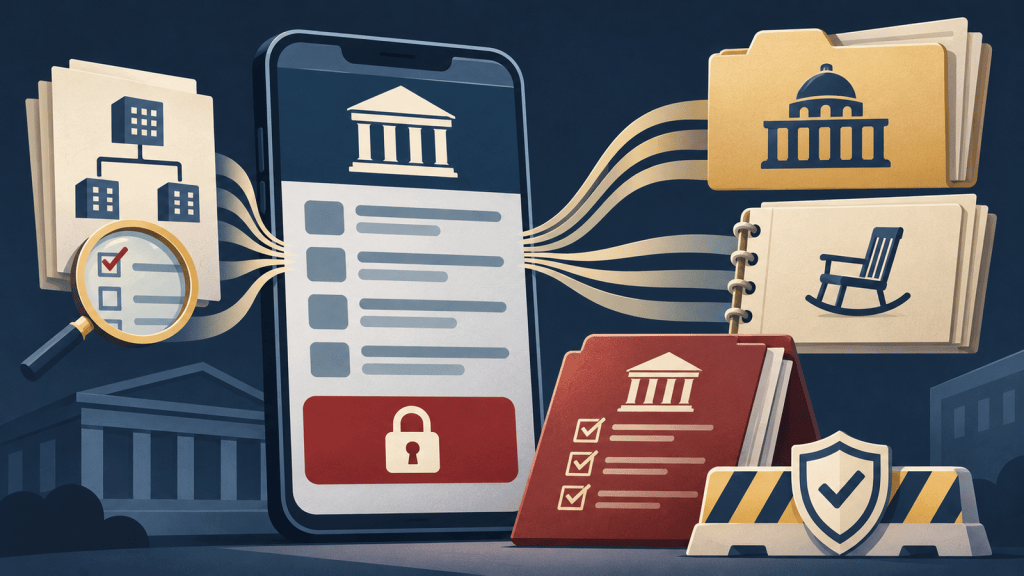
Paraguay’s resolution of ueno bank is a reminder that a regulated bank can still become a concentrated operating dependency. The immediate story is a bank failure and political crisis. The finance lesson is broader: when public agencies, pension systems and millions of households depend on one fast-growing institution, counterparty risk becomes a continuity problem before it becomes a final-loss calculation.
The judgment
- Implication: Deposit insurance and bank supervision do not replace treasury concentration limits, related-party credit scrutiny or tested access-to-cash alternatives. A reimbursement promise can protect value while operations still fail in the interim.
- What would change the conclusion: The concentration concern would ease if verified resolution data show that public entities retained uninterrupted access to operating cash, most depositor payments were completed quickly, and the final asset review establishes that losses and delays were materially smaller than current evidence suggests.
- Management action: CFOs and boards should map every bank relationship by legal entity, available balance, uninsured exposure, payment dependency and time-to-access under stress—then pre-authorize transfer, payroll and vendor-payment alternatives before a counterparty enters resolution.
What the evidence establishes
On November 3, the Central Bank of Paraguay announced that its board had begun ueno’s resolution process after adjustments to the bank’s financial statements left its solvency ratio below 50% of the required minimum. The central bank said the process was intended to protect depositors and preserve financial stability. That is the regulator’s determination, not an estimate by this publication.
The next day, Paraguay’s Public Prosecutor’s Office said it had charged 27 people over alleged financial irregularities. Prosecutors described loans and overdrafts to affiliated companies that allegedly had weak guarantees, inadequate documentation and amounts disproportionate to borrowers’ capacity. They also cited a roughly $74.4 million loan-portfolio transfer that, under the prosecution’s theory, was indirectly financed with the bank’s own funds. These are allegations in an active investigation, not adjudicated facts.
Reuters reported on November 8 that ueno had attracted about 3 million customers in a country of roughly 6.5 million people and that public institutions, including the state pension fund, held about $850 million with the bank as of June. Reuters also reported that the resolution froze access for nearly 3 million customers and that the deposit-guarantee system had paid about $160 million to almost 1.2 million savers by Saturday.
Reuters reported that President Santiago Peña was impeached after attempting to resign, was arrested and was charged with breach of trust and using office for personal gain. Peña has denied wrongdoing and pleaded not guilty. The political facts matter because they turn a balance-sheet event into an institutional-confidence test; they do not, by themselves, prove the underlying financial allegations.
Solvency protection is not the same as cash access
Deposit guarantees answer an important question: how much eligible value may ultimately be protected? Operating finance asks a different one: which obligations can be met today?
A pension agency, municipality, nonprofit or company can be economically protected and still face payroll, benefit, grant or vendor disruption while accounts are frozen, claims are validated and payments are routed. The gap between expected recovery and usable cash is a liquidity exposure. It should be measured in hours and payment cycles, not only as a percentage of deposits.
This distinction is central to earlier Numbers & Judgment analysis of bank-resolution funding: a credible funding source is not operational until legal authority, collateral, settlement and communications work under pressure. Ueno adds the depositor side of that problem. A treasury team needs to know whether it can move money and continue critical payments while the resolution machinery starts.
Public money needs a second concentration test
Treasury policies often cap cash at one institution by balance, credit rating or insured amount. Those controls are necessary but incomplete when a bank also becomes a payment platform, benefit-distribution channel and repository for multiple public entities.
The relevant concentration measure is the combined dependency:
- Balance concentration: cash and investments exposed to one legal counterparty.
- Flow concentration: the share of payroll, benefits, collections and vendor payments routed through it.
- Beneficiary concentration: how many people or programs lose access if the channel stops.
- Control concentration: whether oversight, credit approval and public-funds placement share relationships that weaken independent challenge.
A bank may pass the first test while failing the other three. That is why a counterparty schedule should show not only balances, but also critical transactions, fallback providers, authorized signers, transfer cutoffs and the first obligation that would fail if access stopped.
Related-party credit is a governance signal
The prosecutor’s allegations place related-company lending at the center of the case. The eventual legal findings may differ, but the finance-control lesson does not depend on predicting the verdict: rapid growth plus concentrated lending plus weak documentation is a combination that should trigger independent review.
For bank boards, the review should test beneficial ownership, connected exposures, collateral quality, borrower cash generation, exceptions and whether loans are being refinanced or transferred in ways that obscure deterioration. For public depositors, due diligence should include governance and enforcement signals rather than relying only on a license, brand visibility or reported customer growth.
The same principle appears in the publication’s analysis of control capacity: transaction volume and growth change the amount of monitoring, evidence and challenge a control system must supply. Controls that were adequate for a smaller institution can become dangerously thin when customers, products and related exposures expand faster than verification capacity.
A practical treasury response
The answer is not to predict every bank failure. It is to make a single failure survivable.
- Set separate limits for total balance, uninsured balance and critical payment flows.
- Maintain at least one tested secondary bank or payment route for payroll, benefits and essential vendors.
- Reconcile legal ownership, beneficial ownership and related-party exposure in counterparty reviews.
- Define who can authorize emergency transfers and what evidence is required when senior approvers are unavailable.
- Run a resolution drill that assumes accounts are visible but unusable, public communications are incomplete and recovery timing is uncertain.
The free Board Finance Dashboard can help put cash coverage, reserve position, concentration and near-term movement on one page. It does not replace bank-level due diligence, but it makes the board-level tradeoff visible: a strong cash balance is less protective when too much of it, or too many essential flows, depend on one institution.
The larger lesson
Digital distribution can expand access quickly. It can also allow operational dependence to scale faster than treasury policies and public oversight. Ueno’s resolution is therefore not only a story about one bank’s solvency. It is a warning about the difference between financial inclusion and concentrated financial infrastructure.
For CFOs and boards, the test is simple to state and difficult to pass: if the primary bank were unavailable tomorrow, could the organization still make its most important payments, prove who owns the funds and communicate a credible recovery plan? If the answer depends on the bank continuing to operate normally, the treasury plan is incomplete.
Sources
- Central Bank of Paraguay: resolution of ueno bank, November 3, 2026.
- Public Prosecutor’s Office: charges and alleged financial irregularities, November 4, 2026.
- Reuters: How a digital bank’s collapse toppled Paraguay’s president, November 8, 2026.
- Associated Press: Paraguay bank collapse and political crisis, November 5, 2026.


Leave a Reply