October 13, 2026 · News Analysis · Robert Young
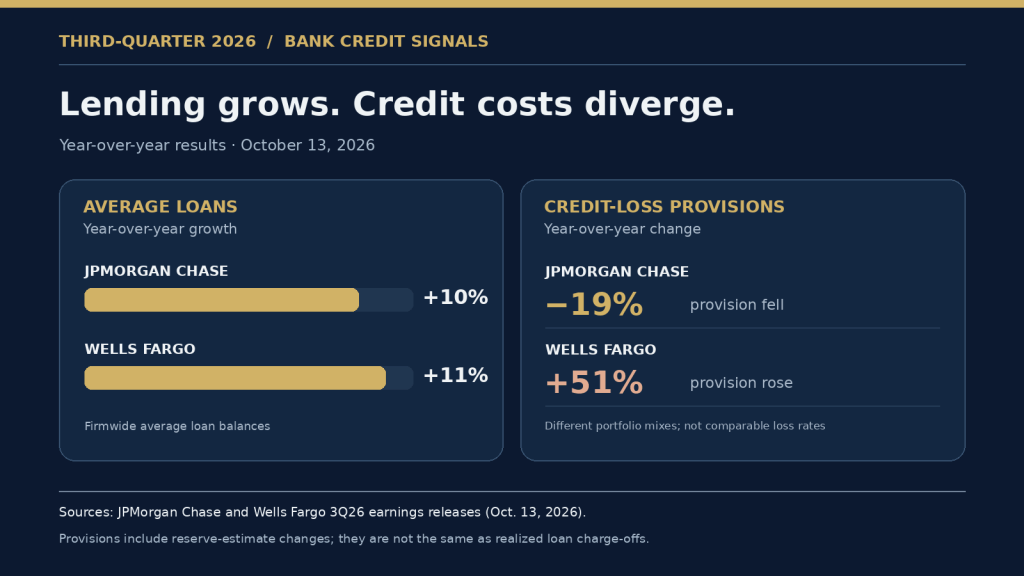
The first major U.S. bank results for the third quarter show lending and deposits expanding, not the abrupt contraction that would normally accompany a broad credit break. Yet the loss picture is not uniform. JPMorgan Chase reported lower credit-loss provisions than a year earlier, Wells Fargo reported higher provisions, and Citi described rising credit-card borrowing alongside higher U.S. card provisions. The distinction matters more than whether any one bank beat an earnings-per-share forecast.
These are signals from large, diversified lenders—not a complete census of small-business credit, households, community banks or borrowers approaching refinancing. For CFOs, investment committees and nonprofit finance leaders, the lesson is to keep the baseline operating forecast intact when supported by evidence, while separately stress-testing who would bear the cost of more expensive and selective financing.
The judgment
- Implication: The reported quarter supports continuing loan demand and resilience at major banks, but widening differences in provisions argue against declaring credit risk resolved.
- What would change the conclusion: A sustained rise in delinquency and charge-off rates across multiple portfolios, deterioration in bank funding conditions, or broad loan contraction would point toward systemic stress. More quarters of healthy repayment, deposit retention and loan growth would strengthen the resilience case.
- Management action: Model refinancing capacity and customer payment exposure by borrower segment, not from bank earnings or headline stock-market performance alone; put liquidity contingencies beside the base forecast.
The lending evidence is positive—within limits
JPMorgan’s October 13 earnings release reports average loans of $1.6 trillion, up 10% year over year, and average deposits up 8%. Firmwide net interest income excluding markets rose 6% to $24.7 billion. The reported $15.3 billion of net income and $5.57 diluted earnings per share included an investment-securities loss; that item helps explain why an earnings miss is an imperfect measure of the underlying credit cycle.
Wells Fargo reported average loans of $1.033 trillion and deposits of $1.483 trillion, each approximately 11% higher than a year before. Net interest income grew 5% year over year to $12.52 billion. The bank’s financial release attributed interest-income growth to a combination of balance-sheet growth, fixed-rate asset repricing and rate effects; it did not suggest every customer benefited from higher rates.
Citi’s U.S. general-purpose credit-card spending volume rose 13% and average card loans rose 9% from a year earlier, according to Reuters’ account of its results. This measure covers a product segment rather than the whole firmwide loan book: it should not be plotted as though it were comparable with JPMorgan’s or Wells Fargo’s total average loans. Higher spending is evidence of continued activity; more card loans could reflect purchase volume, repayment choices or both.
The provisions tell a more complicated story
JPMorgan recorded $2.74 billion of provision for credit losses, down from $3.40 billion in the prior-year quarter. Its $2.2 billion of net charge-offs was also lower year over year. Importantly, JPMorgan still built reserves by $539 million, principally in wholesale lending; it was not reporting a completely risk-free environment.
Wells Fargo’s provision increased from $681 million to $1.03 billion. Its net charge-offs were $983 million, compared with $954 million a year earlier. The company reported a 0.38% annualized net-loan-charge-off rate versus 0.40% a year ago; the dollar amount and the rate can move differently as the loan denominator grows. The provision increase also reflected higher allowances associated with commercial and industrial and auto loan balances, partly offset by a decline in commercial-real-estate allowances.
Citi’s U.S. consumer-card provisions were about $1.9 billion, up 4% year over year, according to Reuters. Profits in its card business fell despite higher purchase volume, reflecting reward and partner costs as well as credit provisioning. The move is a caution at the margin, not proof that the overall banking system has entered a generalized credit-loss cycle.
A comparison caveat is essential: JPMorgan’s firmwide provision, Wells Fargo’s firmwide provision and Citi’s U.S. consumer-card provision cover different populations and accounting bases. They demonstrate dispersion, not a harmonized ranking of credit quality. Even within a single bank, provisions reflect forward-looking expected-loss estimates and reserve decisions, while charge-offs capture realized loan losses.
Higher interest income is not a clean sign of borrower strength
A bank can grow net interest income when loan balances increase, assets reprice or its funding mix changes. Its customers may simultaneously confront more expensive credit. Comparing interest-income growth with borrower health therefore requires looking at deposits, delinquency rates, refinancing terms and specific loan types, not treating margin improvement as an economy-wide benefit.
The capital-markets side gives a second reason to separate earnings performance from lending conditions. JPMorgan reported equity-markets revenue up 49% but fixed-income-markets revenue down 4% year over year. Goldman Sachs reported strong equity-trading and underwriting results in a different business mix. Neither strong trading profits nor a disappointment versus analyst consensus directly measures whether a small company can refinance at an affordable spread.
Where a CFO or board should focus
Refinancing exposure
Build a maturity and repricing schedule for outstanding debt, leases and committed facilities. Recalculate interest coverage and cash obligations using the terms available to the organization—not the rates implicit in large-bank earnings. Test a realistic delayed refinancing or reduced borrowing base and identify what spending or working-capital decisions would follow.
Customer and counterparty quality
Map major customers by payment behavior, industry concentration and access to capital. A lender’s broad portfolio can perform well even if a concentrated group of your customers experiences distress. Track aging, collection terms and customer exposure against the actual cash forecast. Avoid assuming the same loss outlook applies to cards, small-business credit and commercial real estate.
Treasury and liquidity
Separate reported profits, committed funding and cash actually available for payroll and operations. Maintain a forward cash forecast with downside assumptions for slower collections or higher borrowing costs. When modeling multiple outcomes, show both what would change the forecast and which management action would be taken; a stress case without a decision attached is little more than a chart.
What would signal a more serious break?
- Credit performance: broad, persistent deterioration in delinquency, charge-off and nonaccrual measures, especially when adjusted for portfolio growth and changing composition.
- Access to finance: materially tighter underwriting, reduced lines or failed refinancings across sectors rather than an isolated distressed borrower.
- Cash transmission: slower customer collections, rising supplier demands for faster payment, and a widening divergence between book earnings and cash conversion.
None of these indicators can be inferred conclusively from a single quarterly earnings day. Further bank reports, regulatory data and actual borrower terms will determine whether the apparent resilience is sustained or masks increasing pockets of fragility.
The decision
This earnings cycle does not yet demonstrate a broad credit break, but it does reveal uneven credit costs beneath generally expanding balance sheets. For operating-finance decisions, the defensible course is neither to forecast a recession from one higher provision nor to ignore refinancing risk because bank profits remain strong. Preserve the distinction between the economy-wide signal and the organization’s own exposure—and attach an action to each plausible downside.
Related reading and tool
Related Numbers & Judgment analysis: Household Wealth Rose While Payment Stress Worsened and Bank-Resolution Funding Plans Remain Incomplete. Use the free 13-Week Cash Flow Forecast to model actual receipts, obligations and a downside timing case.
Sources and method
- JPMorgan Chase, third-quarter 2026 earnings release (October 13): loan, deposit, provision, charge-off, interest-income and trading figures.
- Wells Fargo, third-quarter 2026 earnings release (October 13): growth, interest income, loss and reserve figures.
- Reuters, Citi third-quarter 2026 results (October 13): card activity and provisions.
- Goldman Sachs, third-quarter 2026 results (October 13): capital-markets comparison.
Reported figures are attributed to the source releases and coverage above. Ratios and percentages are quarter-to-quarter or year-over-year as labeled, not a live market feed. The assessments of operating-finance implications are independent Numbers & Judgment analysis, not a prediction or personalized investment recommendation.


Leave a Reply