October 12, 2026 · News analysis · By Robert Young
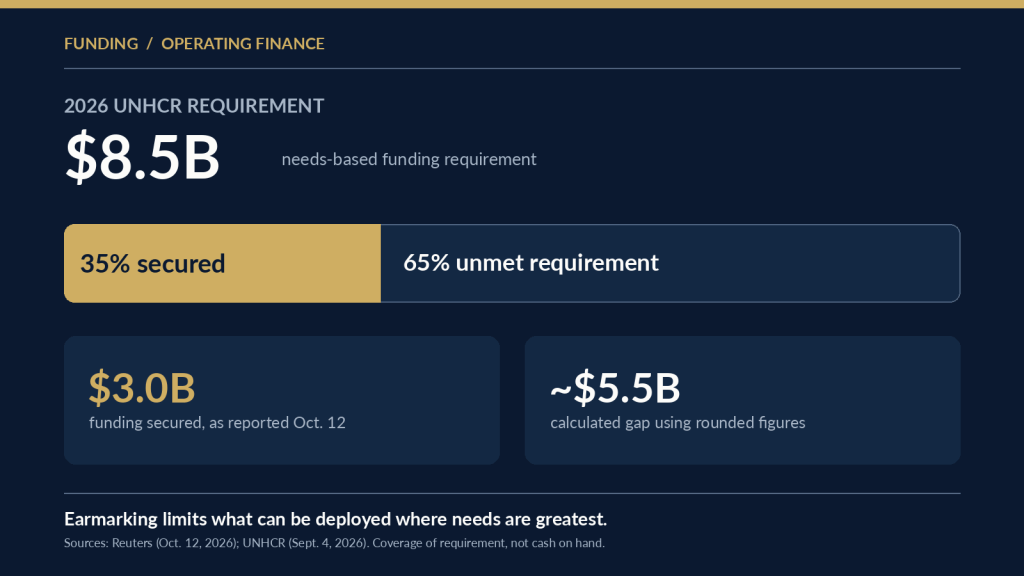
UNHCR says it has secured about $3 billion against $8.5 billion in required funding for 2026. That is roughly 35% coverage of its needs-based budget, even after a major restructuring and sharp workforce reductions. The arithmetic is stark; the operating problem is harder. An organization can reduce overhead, protect its most critical positions and still lack the flexible resources needed to keep essential services functioning.
The UN refugee agency’s October 12 report to its Executive Committee makes this a finance-governance story as much as a humanitarian one. The question for nonprofit boards is not simply how to close a deficit. It is how to identify the minimum service capacity that must be financed, distinguish money raised from money actually available for that purpose, and avoid promising a level of service the forecast cannot support.
The judgment
- Implication: Cost restructuring can extend the runway but cannot by itself close a funding gap of this scale. Restricted contributions and differences between pledged, available and usable resources can make the operating shortfall more severe in specific programs than a single fundraising percentage suggests.
- What would change the conclusion: Material additional funding that is available when services need it—and sufficiently flexible to reach underfunded activities—could improve the outlook. Verified restoration of interrupted services and sustainable staffing would matter more than a fundraising announcement alone.
- Management action: Define the essential-service floor, prepare a weekly unrestricted-cash and commitment forecast, and require explicit board decisions whenever forecast resources fall below the cost of that floor.
A 35%-funded budget is not a 35%-funded service
At its October 12 meeting, UNHCR High Commissioner Barham Salih reported approximately $3 billion secured against an $8.5 billion 2026 requirement, according to Reuters. On these rounded figures, the unfilled requirement is about $5.5 billion. That is an appeal or budget coverage gap, not an assertion that the agency has a negative $5.5 billion cash balance or that every operation is uniformly 35% funded.
The distinction matters. A needs-based budget describes what the agency estimates is required to meet obligations and identified needs. Funding availability is a different measure. A third measure—how much of the money is usable in a particular geography, program and week—can be more restrictive still. For an operating decision, those three columns cannot be merged.
In a September 4 briefing, UNHCR said more than half of projected 2026 contributions were tightly earmarked. The agency warned that restricted funding can create mismatches between resources and urgent operational needs. This September statement concerned the composition of projected funding, whereas the October $3 billion figure concerns funding secured. They should not be combined into a precise unrestricted-cash calculation: the timing, restrictions and denominators differ.
Workforce reductions have a limit
Reuters reports that UNHCR’s workforce fell from approximately 20,000 in 2024 to fewer than 12,000 in October 2026. That is a decline of more than 40% using the rounded reported totals. The agency sought to concentrate the remaining resources outside headquarters and preserve specialist protection capacity. Salih said approximately 88% of staff remained outside headquarters and roughly 95% of protection-related personnel were retained in field locations.
These are meaningful management choices, but they are not evidence that the remaining service model is fully financed. Reuters described risks to specialized medical and legal support for displaced people in Chad and interruptions to refugee registration in Ethiopia. When funding falls far enough, a program’s remaining headcount cannot substitute for the missing supplies, partners, contracted services or operating cash needed to deliver assistance.
The finance lesson is not that overhead reduction is futile. It is that the cost structure has a threshold below which further cuts remove productive capacity rather than inefficiency. Boards need evidence of which savings preserve output, which merely postpone an obligation, and which directly reduce essential service.
Earmarking turns fundraising into an allocation problem
Consider two illustrative programs. Both have an approved operating plan and a committed service population. One receives a donor-restricted grant sufficient to cover its activities; the other depends on flexible contributions that are arriving slowly. An aggregate fundraising report may show progress while the second program is approaching a service interruption. This is an illustration, not a description of UNHCR’s internal allocations.
The monthly fundraising total therefore belongs alongside a restriction-adjusted funding schedule. Finance leadership should reconcile each major source to the activities, locations and periods it may legally support, its cash receipt timing, and any conditions that must be met. More unrestricted funding can be operationally valuable even when it does not increase the headline appeal total as much as a larger restricted pledge.
The Americas reveal the mismatch between needs and resources
Reuters reported that UNHCR’s planned 2027 budget for the Americas is approximately 32% below 2026, or about $485 million lower, while the number of forcibly displaced and stateless people in the region is projected to rise about 4% to 24.5 million. The figures are a planning comparison, not proof of the eventual realized 2027 spending or service outcome.
A falling regional budget amid rising projected need is not automatically an efficiency failure: costs, program design, partnerships and mandated responsibilities can change. It does, however, create a test management should answer explicitly: Which activities will deliver similar outcomes at lower cost, and which services or populations will instead receive less support? Unless those quantities are separated, ‘productivity’ can become a label for unmet demand.
A CFO playbook when funding cannot support the promise
1. Price the non-negotiable service floor
List the activities whose interruption would cause the most serious mission, legal or safety consequences. Assign their minimum credible staffing, vendor, partner and infrastructure requirements. Review this floor with program leadership; finance alone should not decide which services are essential. Record what will be deferred, reduced or transferred if even that floor cannot be funded.
2. Forecast usable cash rather than total awards
Build a rolling 13-week view of bank cash, expected unrestricted receipts, eligible restricted receipts, payroll, partner payments and unavoidable commitments. Keep pending grants and donor indications separate from confirmed, collectable amounts. Link each scenario to the first week an obligation cannot be met, with the underlying restriction clearly identified.
3. Establish triggers and decision rights
Board policy should specify who may approve service changes, the conditions for using reserves, when to notify funders, and which changes require formal program or legal review. The thresholds should be based on the organization’s own service obligations and risk tolerance; no universal cash-months rule can replace that analysis.
4. Report the unmet need honestly
Show four different measures: resources requested, resources committed, resources available for deployment, and services actually delivered. Add the cost and scale of unmet demand. Distinguish permanent reductions from delays and reductions in scope. If a restricted grant keeps one initiative going while another is suspended, the board should be able to see both facts.
5. Negotiate flexibility before the crisis peaks
Where donors permit, seek changes in grant purpose, payment timing, indirect-cost recovery or reporting mechanics. Diversifying donors and building reserves can reduce future concentration risk, but neither is an instant cure. Significant restrictions may require donor consent and legal review before any reallocation.
What evidence comes next
UNHCR has indicated that a December donor pledging conference could improve 2027 funding expectations; that outcome remains uncertain. The useful next evidence is not the headline value of pledges alone. It is how much becomes available, how promptly, under what restrictions, and whether currently interrupted or threatened functions actually recover.
For other nonprofits, the takeaway is practical. Budget reductions are not the same as restored financial sustainability. When the remaining available resources cannot pay for an essential service floor, management and boards must make the trade-off visible—and tell funders the cost of leaving it unresolved.
Related reading and a free tool
For board-level action thresholds, see A Reserve Policy Without Trigger Points Is Just a Number. For the way financing stress can become a mission-continuity problem, see HomeRise Wind-Down Puts Service Continuity on the Balance Sheet. The free 13-Week Cash Flow Forecast can help translate receipt timing and restricted availability into management actions. Its example inputs are fictional and must be replaced with an organization’s actual data.
Sources and method
- Reuters, Olivia Le Poidevin, October 12, 2026 — coverage of UNHCR’s Executive Committee remarks, 2026 available funds, staffing, service risks, Americas planning and December outlook.
- UNHCR, All Member State briefing with the High Commissioner, September 4, 2026 — primary statement on projected funding, earmarking and financial discipline.
- UNHCR, 77th Executive Committee session, October 12–16, 2026 — official meeting context and budget documentation.
Reported numbers, projections and management statements are attributed to their sources. Calculated differences use rounded reported totals; operating-finance frameworks and conclusions are Numbers & Judgment analysis. This is not a representation of any private employer’s finances.


Leave a Reply