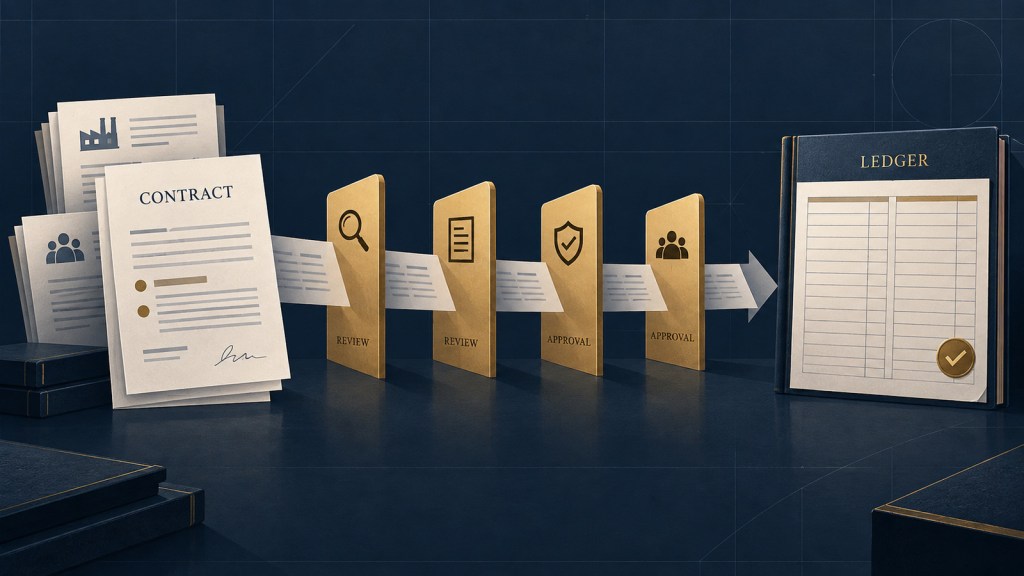
Endava’s outside auditors raised concerns about how the technology-services company accounted for certain customer and supplier agreements. The resulting board investigation is still open, and it has not established a misstatement, restatement, fraud or misconduct. But the disclosure already carries a practical lesson for finance teams: accounting risk often begins when commercial terms are negotiated, not when journal entries are posted.
The judgment
- Implication: For nonstandard arrangements, a quarter-end review is too late. Pricing concessions, customer credits, supplier reimbursements and bundled promises should enter a documented accounting review before the contract is signed.
- What would change the conclusion: Endava’s investigation could determine that its existing process and accounting were appropriate, or that the issue was narrow and immaterial. Until the company reports the findings, conclusions about its financial statements would be premature.
- Management action: Build a contract-to-ledger control chain that flags unusual terms at proposal stage, assigns an accounting owner and preserves the approval evidence through billing, procurement, recognition and disclosure.
What Endava actually disclosed
In a Form 6-K filed September 21, Endava said its board appointed Conor McShane of AlixPartners as interim chief financial officer and designated him principal financial officer and principal accounting officer, effective that day. The board also placed CFO Mark Thurston on administrative leave pending an investigation by independent outside counsel for the Audit Committee.
The filing says the investigation began after Endava’s outside auditors raised concerns about “the Company’s accounting treatment of certain customer and supplier agreements and related matters.” It also says the company expects to report fiscal fourth-quarter and full-year 2026 results later than its historical schedule, while still intending to file its Form 20-F by the November 2 SEC deadline.
Those are the reported facts. Endava has not said which contracts are involved, which accounting judgments are under review, whether prior statements are affected or whether any control deficiency exists. Administrative leave and an investigation are not findings of wrongdoing.
The rest of this article is Numbers & Judgment analysis: a control framework suggested by the kind of issue Endava disclosed, not a claim about what investigators will find.
A contract can alter several lines at once
“Customer and supplier agreements” is a small phrase with a wide accounting perimeter. Technology-services contracts can contain a base service promise plus implementation work, usage pricing, service-level credits, milestone payments, change orders, minimum commitments, customer-funded tooling, third-party software or cloud costs, and supplier rebates. The legal documents may also be spread across a master agreement, statement of work, purchase order and later email amendment.
Each term can be commercially sensible. The difficulty is that the terms may interact. A concession described as a future discount can affect the transaction price. A supplier payment can be either a reduction of cost or payment for a distinct service. A change order can modify an existing contract or create a separate one. A bundled promise can affect how consideration is allocated and when revenue is recognized.
The IFRS Foundation’s summary of IFRS 15 makes the chain explicit: identify the contract and performance obligations, determine and allocate the transaction price, then recognize revenue as those obligations are satisfied. That sequence starts with understanding the commercial arrangement. The ledger is an output of that understanding, not a substitute for it.
Why downstream review is structurally weak
Many finance organizations still treat technical accounting as a final checkpoint. Sales negotiates the customer economics. Procurement negotiates the supplier economics. Legal confirms enforceability. Operations decides how the work will be delivered. Finance receives the signed documents and determines the entries.
That sequence creates three problems.
- Information decays. The people entering a transaction understand which concessions were essential, which commitments were contingent and which side understandings changed the economics. Months later, accounting may see only formal documents and fragmented correspondence.
- Options disappear. Before signature, a company can simplify terms, separate deliverables, clarify acceptance criteria or change approval language. After signature, finance usually must account for the arrangement that already exists.
- Testing becomes sample-dependent. A quarter-end control may review only large contracts or a sample of amendments. If the risk is an unusual clause rather than contract size, a dollar threshold alone can miss it.
This is why contract review belongs in the same family as the internal-control questions discussed in the SEC assurance-threshold analysis: the reliability of reported numbers depends on where evidence is created, who challenges it and how long the feedback loop takes.
The contract-to-ledger control chain
A stronger process does not require an accountant to review every standard order. It requires a route for exceptions to reach the right people early.
- Commercial proposal. Sales or procurement records the expected economics, including concessions, contingent payments, bundled work and third-party dependencies.
- Exception screen. A short intake identifies nonstandard clauses: side letters, rebates, credits, outcome-based pricing, unusual acceptance terms, material change orders, linked customer-and-supplier arrangements or commitments outside approved templates.
- Accounting assessment. A controller or technical-accounting owner documents the relevant judgment, evidence, policy and expected financial-statement effect. Materiality matters, but unusual structure should be an independent trigger.
- Legal and operational confirmation. Legal confirms the enforceable terms; operations confirms what will actually be delivered and when. Accounting should not infer performance obligations from boilerplate alone.
- Approval before signature. The contract cannot proceed until required finance exceptions are resolved. The approval should attach to the final executed version, not an earlier draft.
- Billing and procurement setup. Contract data flows into billing schedules, purchase commitments and project systems using the approved accounting treatment.
- Recognition and reconciliation. Finance compares invoices, delivery evidence, supplier activity and ledger results with the documented judgment. Amendments restart the assessment when economics change.
- Disclosure and close review. Quarter-end controls test whether the process operated, whether estimates changed and whether concentrated or unusual judgments require disclosure.
The central design principle is traceability. A reviewer should be able to move from the reported result back to the recognition conclusion, the executed terms, the exception approval and the original commercial rationale.
AI-era service models raise the stakes
The issue is especially relevant as technology-services companies redesign offerings around AI. Endava said in its May 21 third-quarter results that AI-driven business had risen from 5% to 15% of revenue over a year. The same release reported quarterly revenue of £178.5 million, down 8.4% year over year, and adjusted profit before tax of £3.2 million, or 1.8% of revenue. Those figures provide business context; they do not establish any connection to the agreements under investigation.
As AI delivery models evolve, contracts may move from time-and-materials billing toward consumption, shared savings, performance outcomes or hybrid arrangements involving outside model and infrastructure providers. The commercial promise, delivery evidence and supplier economics can become more interdependent. That makes an upstream review more important, not because AI changes accounting principles, but because it changes the facts to which those principles apply.
The governance lesson parallels the broader need to govern AI inside finance: new operating models can outrun controls designed around familiar transactions. Finance should respond by shortening the distance between commercial design and accounting judgment.
What boards should ask now
An audit committee does not need contract-by-contract detail. It does need evidence that management knows where unusual terms enter the business and how those terms reach accounting.
- Which contract terms trigger pre-signature controller review?
- Do linked customer and supplier arrangements receive a combined assessment?
- Can commercial teams alter an approved template through side letters, email commitments or change orders without restarting review?
- How does finance verify that the executed contract matches the version it approved?
- What percentage of exception reviews occur before signature rather than during the close?
- Which judgment-heavy contracts are revisited when delivery facts or estimates change?
Those questions fit naturally into a board control dashboard; the free Board Finance Dashboard Template can be adapted to track contract exceptions, overdue accounting assessments and unresolved close items.
The real control is timing
Endava’s investigation may ultimately identify a narrow issue, a broader process problem or no material error. The available disclosure does not support choosing among those outcomes.
It does support a wider management conclusion. Contract economics and accounting cannot be safely separated into sequential functions. When a transaction is unusual, the most effective financial-reporting control may be the one that operates before the company becomes legally committed—while terms can still be clarified, evidence can still be assembled and the economics can still be changed.
 Numbers & Judgment
Leave a comment